Today's
EarthStation1.com 15% Off Commemorative Memorial Title: TV
Commercials: The Cable Age Classics Vol. 4 MP4 Video Download DVD
Today, March 10, 2026
March 10: National Ranch Day: -- You
should put Ranch on everything. We mean it. Everything. Because
honestly, what dish isn't made better by Ranch? Fries? Absolutely.
Sandwiches? You bet. Ice cream? Okay, maybe. For today only,
calories don't count and the only law of the land is Ranch. Round
up some friends for a Ranch taste test to determine the superior
Ranch, try your hand at some new Ranch-inclusive recipes, or just
use the iconic hashtag #RanchEverything. For some high-quality
food-spo and a history of man's perfect food, read on! Hidden
Valley claims to have created the first Ranch back in 1954, on its
dude ranch in the mountains outside of Santa Barbara - pretty
idyllic for the birth of the one true dressing. Legend has it that
plumber-turned-cowboy Hidden Valley rancher Steve Henson first
established the ranch and cooked for his guests, covering his
meals with a tantalizing mix of buttermilk and herbs. Steve began
to package his dressing and send it off with guests, but the
demand became unmanageable. Eventually, Ranch hit Southwestern
supermarkets and then traversed the nation, forcing the production
of the heavenly liquid to be moved to a larger facility in Sparks,
Nevada. Gone were the days of the home-style seasoning packets
handed out to friends and neighbors to be mixed with buttermilk
and mayo. In 1972, Clorox bought Hidden Valley Ranch dressing for
8M USD, and Kraft Foods and General Foods were quickly hit with
lawsuits for trying to create their own Ranch varieties. While
staving off copycats, Clorox was hard at work revamping the recipe
to exclude expensive buttermilk and developing a pantry-friendly
bottled version that required no refrigeration. The varieties of
Ranch and methods of consumption proliferated into the 1980s.
Soon, Ranch lovers were snacking on Cool Ranch Doritos and Hidden
Valley Ranch Wavy Lay's chips, while children were given the
option of taco or pizza-flavored Ranch dressings. Even dry
Ranch-flavored seasoning was shaken on popcorn nationwide. Many
companies, like Ken's, Kraft, Newman's Own, and Marie's, threw
their names into the Ranch ring since Hidden Valley originated the
condiment, and we're all the better off for it. Ranch is one of
the most popular and best-selling dressings in the United States
and Canada and routinely rises above the salad from whence it
came. With increasing levels of creativity, people are constantly
innovating Ranch-centric dishes and concoctions - from adding it
to fried vegetables to fried cheesecake (we're not sure about that
one). We think Ranch deserves all the credit it's going to receive
on this special day! On Sale @ 15% Off Discount Till Midnight PT!
https://store.earthstation1.com/tv-commercials-the-cable-age-classics-vol-4-mp4-video-download-d44.html
Today's
EarthStation1.com 15% Off Commemorative Memorial Title: How To
Speak Hip Del Close John Brent Comedy Album MP3s, CD, USB Drive
Today, March 10, 2026
March 10: International Wig Day: -- Not
only is it an opportunity to not worry about how your hair looks,
but it's also a chance to express yourself. What's great about
International Wig Day is that it serves multiple purposes. First,
it's fun! Who doesn't want to spend a whole day celebrating wigs
for all the color and spice they bring to our lives. Second and
more importantly, it aims to raise awareness for hair loss caused
by diseases and cancer treatments. The day is an easy way to show
your support for the fight against cancer. Although wigs have been
around for millennia, we've only been celebrating International
Wig Day since 2016. A costume shop in Denmark, temashop.dk, came
up with the idea to appreciate wigs for the fun they bring to our
lives and to raise awareness around cancer. Wigs can be traced
back to ancient Egypt where people would sometimes shave off their
hair and wear wigs to protect their heads from the extreme heat in
those regions. They were also worn for important events. The
Assyrians, Greeks, Phoenicians, and Romans also wore fake
hairpieces. Many of us think that it's mostly women who wear wigs
and that it has been that way for centuries. But like many other
accessories - wigs were originally made for everyone. We've all
seen those luscious white locks of hair aristocratic men wear in
period dramas. Those wigs, or perukes, became popular in the
United Kingdom, France, and other European countries in the 16th
century. Today, men's wigs are commonly called toupees and they're
worn throughout the world. Wigs have a long history. But
unfortunately, and only recently a kind of stigma has been
associated with them. Some people think that wig-wearers are
hiding something and can unleash a barrage of unnecessary
questions such as "is that your real hair?" Now's the
time to shrug off any shame in wearing a wig and hold your head up
high. People can wear wigs for all kinds of reasons and it's
refreshing to see them becoming more acceptable today. Many actors
and social media influencers are also becoming more vocal about
wearing wigs leading to a rise in their popularity. On Sale @ 15%
Off Discount Till Midnight PT!
https://store.earthstation1.com/del-close-john-brent-how-to-speak-hip-comedy-album-lp-mp3-c3.html
Today's
EarthStation1.com 15% Off Commemorative Memorial Title: The Old
Time Radio Sci-Fi & Paranormal MP3 MegaSet CD, Download, USB
Today, March 10, 2026
March 10: International Bagpipe Day: --
Can you believe that bagpipes date back to 400 B.C., and are
thought to have originated from Egypt, with the first players
known as pipers of Thebes? Bagpipes are distinct and unique
musical instruments that hold a special place in certain parts of
Europe, such as Scotland and Ireland. A bagpipe is a type of
woodwind instrument that consists of several parts including the
air supply blowpipe, the bag, the chanter, the chanter reed, and
the drone or drones. The chanter is the melody pipe that can be
played by the piper, whereas the drone or drones provide a
constant note. It has a long and rich history that dates back to
ancient Rome and Egypt. In the early part of the second
millennium, clear evidence of bagpipes began to appear frequently
in Western European art and iconography. They were also popular
subjects for carvers of wooden choir stalls throughout Europe in
the late 15th century and early 16th century. Andy Letcher and
Cassandre Balosso-Bardin co-founded International Bagpipe Day with
the International Bagpipe Organization and the Bagpipe Society.
Since 1986, the Bagpipe Society has been actively involved in
bringing together new bagpipe players in order to preserve the
history and practice of bagpipes. Cassandre came up with the idea
of organizing a bagpipe conference as part of his efforts to
promote the diversity of bagpipes to a wider audience. The First
International Bagpipe Conference, which gathered musicians and
instrument makers from all over Europe, launched International
Bagpipe Day worldwide. Thousands of pipers around the world now
celebrate the day every year, with many local pipers organizing
events in places such as Harvard (U.S.), Glasgow (U.K.), Haninge
(Sweden), Minsk (Belarus), Iran, and Nigeria. On Sale @ 15% Off
Discount Till Midnight PT!
https://store.earthstation1.com/the-old-time-radio-scifi-paranormal-megaset-dual-layer-mp3-dv3.html
Today's
EarthStation1.com 15% Off Commemorative Memorial Title: The Bix
Beiderbecke Jazz Festival 1991 DVD, MP4 Download, Flash Drive
Today, March 10, 2026
March 10: Bix Beiderbecke Day: -- March
10, 1903: #BOTD: #HBD! Bix Beiderbecke, American jazz pioneer,
cornet player, pianist and composer (d. August 6, 1931) is #born
Leon Bismark ("Bix") Beiderbecke in Davenport, Iowa.
Along with Louis Armstrong and Muggsy Spanier, Bix Beiderbecke was
one of the most influential jazz soloists of the 1920s. His turns
on "Singin' the Blues" and "I'm Coming, Virginia"
(both 1927), in particular, demonstrated an unusual purity of tone
and a gift for extended improvisation that heralded the jazz
ballad style, in which jazz solos are an integral part of the
composition. . With these two recordings, especially, he helped to
invent the jazz ballad style and hinted at what, in the 1950s,
would become cool jazz. Moreover, his use of extended chords and
an ability to improvise freely along harmonic as well as melodic
lines are echoed in post-WWII developments in jazz. There is
disagreement over whether Beiderbecke was christened Leon Bix or
Leon Bismark and nicknamed "Bix". His father was
nicknamed "Bix", as was his older brother, Charles
Burnette "Burnie" Beiderbecke. Burnie Beiderbecke
claimed that the boy was named Leon Bix and biographers have
reproduced birth certificates that agree. More recent research -
which takes into account church and school records in addition to
the will of a relative - suggests he was named Leon Bismark.
Regardless, his parents called him Bix, which seems to have been
his preference. In a letter to his mother when he was nine years
old, Beiderbecke signed off, "frome your Leon Bix Beiderbecke
not Bismark Remeber" [sic]. A native of Davenport, Iowa,
Beiderbecke taught himself to play the cornet largely by ear,
leading him to adopt a non-standard fingering technique that
informed his unique style. He first recorded with Midwestern jazz
ensemble The Wolverines in 1924, after which he played briefly for
the Detroit-based Jean Goldkette Orchestra before joining Frankie
"Tram" Trumbauer for an extended engagement at the
Arcadia Ballroom in St. Louis, also under the auspices of
Goldkette's organisation. Beiderbecke and Trumbauer joined
Goldkette's main band at the Graystone Ballroom in Detroit in
1926. The band toured widely and famously played a set opposite
Fletcher Henderson at the Roseland Ballroom in New York City in
October 1926. He made his greatest recordings in 1927. The
Goldkette band folded in September 1927 and, after briefly joining
bass saxophone player Adrian Rollini's band in New York, Trumbauer
and Beiderbecke joined America's most popular dance band: Paul
Whiteman and his Orchestra. Beiderbecke's most influential
recordings date from his time with Goldkette and Whiteman,
although he also recorded under his own name and that of
Trumbauer's. The Whiteman period marked a precipitous decline in
his health due to his increasing use of alcohol. Treatment for
alcoholism in rehabilitation centers, with the support of Whiteman
and the Beiderbecke family, failed to stop his decline. He left
the Whiteman band in 1929 and in the summer of 1931 he died in his
Sunnyside, Queens, New York apartment at the age of 28. His death,
in turn, gave rise to one of the original legends of jazz. In
magazine articles, musicians' memoirs, novels, and Hollywood
films, Beiderbecke has been envisaged as a Romantic hero, the
"Young Man with a Horn" (a novel, later made into a
movie starring Kirk Douglas, Lauren Bacall, Doris Day, and Hoagy
Carmichael). His life has often been portrayed as that of a jazz
musician who had to compromise his art for the sake of
commercialism. Beiderbecke remains the subject of scholarly
controversy regarding his full name, the cause of his death and
the importance of his contributions to jazz. He composed or played
on recordings that are jazz classics and standards such as
"Davenport Blues", "In a Mist", "Copenhagen",
"Riverboat Shuffle", "Singin' the Blues", and
"Georgia on My Mind". "In a Mist" (1927) is
the best known of Beiderbecke's published piano compositions, and
the only one that he recorded. His piano style reflects both jazz
and classical (mainly impressionist) influences. All five of his
piano compositions were published by Robbins Music during his
lifetime. Bix died on on August 6, 1931 in his apartment, No. 1G,
43-30 46th Street, in Sunnyside, Queens, New York, . The official
cause of death, as indicated on the death certificate, was lobar
pneumonia. Unofficially, edema of the brain, coupled with the
effects of long-term alcoholism, have been cited as contributory
factors. Beiderbecke's mother and brother took the train to New
York and arranged for his body to be taken home to Davenport. He
was buried there on August 11, 1931, in the family plot at Oakdale
Cemetery. On Sale @ 15% Off Discount Till Midnight PT!
https://store.earthstation1.com/the-bix-beiderbecke-jazz-festival-concert-amp-documentary-dvd.html
Today's
EarthStation1.com 15% Off Commemorative Memorial Title: America:
The Second Century Documentary Series DVD, Download, USB
Today, March 10, 2026
March 10: Paper Money Day: -- Celebrates
the anniversary of the day the first United States Notes (or Legal
Tender Notes) were issued in the United States. On this day, we
commemorate the United States' longest-running paper currency. Of
course, the notes have been modified and updated throughout time,
but they helped to establish the foundation for the paper dollars
we use today. If you still have one of the original 1962 notes,
you're holding a priceless piece of American history. The history
of paper money in the United States is a little complicated. While
the first legal tender notes were issued in 1862, paper money
existed before then. During King William's War, on February 3,
1690, the first paper money was printed in Massachusetts to fund
military action. However, that money was merely a bill of credit -
"IOU" from the colony to the soldiers. In 1775, Congress
tried to replicate this on a wider scale, but this failed due to
rapid inflation. In the 1860s, there emerged two forms of
emergency paper currency - Demand Notes, which were issued in
1861, and United States Notes which were issued in 1862. During
the American Civil War, these notes were used to pay for expenses.
The Demand Notes were non-redeemable and began to lose value. Of
the two, it was the United States Note that became authorized as
federal currency by the First Legal Tender Act, which was signed
by President Abraham Lincoln and enacted on February 1862. On
March 10, 1862, the first United States Notes were issued, which
is why we celebrate Paper Money Day on this said date. Of course,
before paper money, there were other methods of exchanging value,
with trade by barter being perhaps the oldest. From barter, we
transitioned into coins, with the Chinese being the first to use
an object resembling the modern-day coin. They were also the first
to move from coins to paper money in 700 B.C. On Sale @ 15% Off
Discount Till Midnight PT!
https://store.earthstation1.com/america-the-second-century-us-2nd-100-years-history-621006.html
Today's
EarthStation1.com 15% Off Commemorative Memorial Title: Remember
When: It'll Never Fly w/ Dick Cavett Inventions DVD, MP4, USB
Today, March 10, 2026
March 10: National Landline Telephone
Day: -- An annucal commemoration of the March 10, 1876 first
successful test of a telephone made by its inventor, Alexander
Graham Bell. Remember when you were forced to leave your phone at
home - because it was attached to your house? Or when your crush
called, but your older brother got to the phone first and revealed
your secret? Or when you knew you hit true best friend status -
memorizing their number? Celebrated on the anniversary of
Alexander Graham Bell's amazing invention, National Landline
Telephone Day remembers the heyday of the landline phone in all
its glory, and makes a strong case for its re-adoption. On Sale @
15% Off Discount Till Midnight PT!
https://store.earthstation1.com/remember-when-it39ll-never-fly-dvd-technology-history-dick-cave39.html
Today's
EarthStation1.com 15% Off Commemorative Memorial Title: Lewis And
Clark & The Corps Of Discovery Expedition DVD MP4 USB Stick
Today, March 10, 2026
March 9-10: Three Flags Day: -- March
9-10, 1804: The United States: The History Of The United States:
The Territorial Expansion of the United States (The Territorial
Evolution of the United States): The Louisiana Purchase: -- March
10: The formal ceremony to transfer ownership of the Louisiana
Territory from France to the United States concludes in St. Louis,
Missouri on the second day of the two-day ceremony known as Three
Flags Day, the first day being the March 9 turning over of New
Spain (Louisiana) by Spain to France, who then officially turned
over the same lands to the United States on the second day, in
order to finalize the 1803 Louisiana Purchase. The ceremony in St.
Louis cleared the way for Lewis And Clark to begin their
exploration. On Sale @ 15% Off Discount Till Midnight PT!
https://store.earthstation1.com/lewis-amp-clark-amp-the-corps-of-discovery-dvd-mp4-usb-driv4.html
Today's
EarthStation1.com 15% Off Commemorative Memorial Title: Lux Radio
Theatre w/ Cecil B. DeMille MP3 Set DVD, Download, USB Drive
Today, March 10, 2026
March 10: National Skirt Day: -- A
special day when women around the country don skirts with pride.
Have a closet full of skirts that you've been meaning to wear for
the longest time? Now is your chance. Celebrate the day in style
by getting all your friends to wear skirts with you. As summer
approaches, a skirt is the perfect easy, breezy go-to attire for
many. Who wouldn't want to get in on this action? This is why
people have been wearing skirts for as long as clothes have been
around. It's safe to say that skirts will be around for centuries
to come. Some say that the origins of National Skirt Day are
unclear, while others claim it was first observed in 1998.
Although skirts have been around for thousands of years, we still
can't get enough of them. They've existed even before people
learned how to stitch clothes together because of their simple
nature and ease of use. The oldest known skirt, made from straw,
was found in Armenia at the Areni-1 cave complex dating back 5,900
years. Back then, skirts were worn by both men and women. Ancient
Egyptian art, in the form of wall and sarcophagus paintings as
well as hieroglyphics also shows both genders wearing skirts
wrapped in a rectangular shape and tied around the waist. The
Sumerians in Mesopotamia wore a kind of fur skirt tied by a belt.
During the Old Kingdom of Egypt, which lasted until 2130 B.C., men
wore short skirts tied at the waist or held by a belt. Over time,
skirts became pleated or gathered. By the Middle Kingdom, longer
skirts were more fashionable while in the New Kingdom, kilts-like
variations with pleated triangular sections became popular. The
material used to make skirts has been constantly evolving. While
earlier they were made from animal skin, straw and linen, today
they're made from almost any material you can think of. Skirts are
still worn by men and women from many cultures, such as the lungi,
lehnga, kanga, and sarong from South and Southeast Asia, and the
kilt worn in Scotland and Ireland. On Sale @ 15% Off Discount Till
Midnight PT!
https://store.earthstation1.com/complete-lux-radio-theatre-2-dual-layer-mp3-dvds-cecil-b-demil23.html
Today's
EarthStation1.com 15% Off Commemorative Memorial Title: Roots Of
Resistance: The Underground Railroad DVD, MP4, USB Drive
Today, March 10, 2026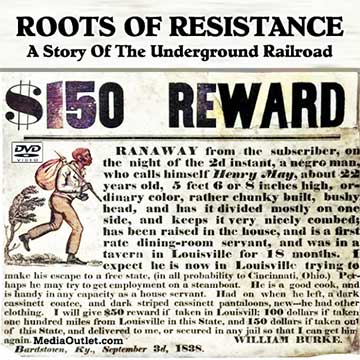
March 10, 1913: National Harriet Tubman
Day: -- #DOTD: #RIP: Harriet Tubman, African American nurse,
activist, abolitionist, humanitarian, and an armed scout and spy
for the United States Army during the American Civil War (b. c.
1820) #dies of pneumonia in an Auburn, New York rest home named in
her honor surrounded by friends and family members, aged 90-91.
Just before she died, she told those in the room: "I go to
prepare a place for you." Tubman was buried with
semi-military honors at Fort Hill Cemetery in Auburn. Harriet
Tubman was born into slavery as Araminta Ross in Dorchester
County, Maryland to enslaved parents, Harriet ("Rit")
Green and Ben Ross. Her nickname was "Minty". She went
on to escape from her masters and thereby from slavery, and
subsequently made some thirteen missions to rescue approximately
seventy enslaved people, family and friends, using the network of
antislavery activists and safe houses known as the Underground
Railroad. She later helped abolitionist John Brown recruit men for
his raid on Harpers Ferry, and in the post-war era was an active
participant in the struggle for women's suffrage. Born Araminta
Ross as a slave in Dorchester County, Maryland, Tubman was beaten
and whipped by her various masters as a child. Early in life, she
suffered a traumatic head wound when an irate slave owner threw a
heavy metal weight intending to hit another slave and hit her
instead. The injury caused dizziness, pain, and spells of
hypersomnia, which occurred throughout her life. She was a devout
Christian and experienced strange visions and vivid dreams, which
she ascribed to premonitions from God. In 1849, Tubman escaped to
Philadelphia, then immediately returned to Maryland to rescue her
family. Slowly, one group at a time, she brought relatives with
her out of the state, and eventually guided dozens of other slaves
to freedom. Traveling by night and in extreme secrecy, Tubman (or
"Moses", as she was called) "never lost a
passenger". After the Fugitive Slave Act of 1850 was passed,
she helped guide fugitives farther north into British North
America, and helped newly freed slaves find work. When the Civil
War began, Tubman worked for the Union Army, first as a cook and
nurse, and then as an armed scout and spy. The first woman to lead
an armed expedition in the war, she guided the raid at Combahee
Ferry, which liberated more than 700 slaves. After the war, she
retired to the family home on property she had purchased in 1859
in Auburn, New York, where she cared for her aging parents. She
was active in the women's suffrage movement until illness overtook
her and she had to be admitted to a home for elderly African
Americans that she had helped to establish years earlier. After
she died in 1913, she became an icon of American courage and
freedom. #HarrietTubman #Abolitionists #UndergroundRailroad
#Activists #AfricanAmericanHistory #AfricanAmericanHeritage
#BlackHeritage #BlackPeople #Blacks #AfricanAmericans
#BlackAmericans #Slavery #SlaveryInTheUnitedStates #SlaveryInTheUS
#AmericanCivilWar #WarBetweenTheStates #WomensSuffrage
#WomensEquality #GenderEquality #SexualEquality #WomensRights
#CivilRights #WomensLiberation #Suffrage #UniversalSuffrage
#GeneralSuffrage #CommonSuffrage #WomensLib #BlackCivilRights
#AmericanHistory #HistoryOfTheUS #WesternCulture
#WesternCivilization #OccidentalCulture #WesternWorld
#WesternSociety #WesternTradition #StoryOfCivilization #MP4
#VideoDownload #DVD On Sale @ 15% Off Discount Till Midnight PT!
https://store.earthstation1.com/roots-of-resistance-a-story-of-the-underground-railroad-dvd.html
Today's
EarthStation1.com 15% Off Commemorative Memorial Title: Tibet
History & The Dalai Lama Documentaries DVD, MP4, USB Drive
Today, March 10, 2026
March 10: Tibetan Uprising Day: -- March
10, 1959: Tibet: The History Of Tibet: The Aftermath Of World War
II: The Cold War: The Cold War In Asia: The Annexation Of Tibet By
The People's Republic Of China: The 1959 Tibetan Uprising (The
1959 Tibetan Armed Rebellion, The 1959 Tibetan Anti-Riot Movement,
The 1959 Tibetan Unrests, The 1959 Anti-Chinese Uprising In Tibet,
The Lhasa Uprising): -- Tibetan Uprising Day commemorates the
beginning of The 1959 Tibetan Uprising (March 10-23, 1959), a
revolt against Chinese rule erupted in Lhasa, the capital of
Tibet, which had been under the effective control of the People's
Republic Of China (PRC) since the Seventeen Point Agreement was
reached in 1951. Fearing a Chinese abduction attempt, 300,000
Tibetans surround the Dalai Lama's palace in the Tibetan capital
of Lhasa to prevent his removal. The 1959 Tibetan Uprising or the
1959 Tibetan Rebellion was a revolt against the effective control
of the People's Republic Of China since the Seventeen Point
Agreement was reached in 1951. Armed conflict between Tibetan
guerillas and the People's Liberation Army (PLA) had started in
1956 in the Kham and Amdo regions, which had been subjected to
socialist reform. The guerrilla warfare later spread to other
areas of Tibet and lasted through 1962. The anniversary of the
uprising is observed by Tibetan exiles as the ''Tibetan Uprising
Day'' and Woman's Uprising Day. The anniversary of its end is
officially celebrated in the Tibetan Autonomous Region as Serfs
Emancipation Day. The 1959 Tibetan Uprising (March 10-23, 1959)
began when a revolt against Chinese rule erupted in Lhasa, the
capital of Tibet, which had been under the effective control of
the People's Republic Of China (PRC) since the Seventeen Point
Agreement was reached in 1951. The anniversary of the uprising is
observed by Tibetan exiles as the ''Tibetan Uprising Day'' and
Woman's Uprising Day. The initial uprising occurred amid general
Chinese-Tibetan tensions and a context of confusion, because
Tibetan protesters feared that the Chinese government might arrest
the 14th Dalai Lama. The protests were also fueled by anti-Chinese
sentiment and separatism. At first, the uprising mostly consisted
of peaceful protests, but clashes quickly erupted and the Chinese
People's Liberation Army (PLA) eventually used force to quell the
protests, some of the protesters had captured arms. The last
stages of the uprising included heavy fighting, with high civilian
and military losses. The 14th Dalai Lama escaped from Lhasa, while
the city was fully retaken by Chinese security forces on March 23,
1959. Thousands of Tibetans were killed during the uprising, but
the exact number of deaths is disputed. Earlier in 1956, armed
conflict between Tibetan guerillas and the PLA started in the Kham
and Amdo regions, which had been subjected to socialist reform.
The guerrilla warfare later spread to other areas of Tibet and
lasted through 1962. Some regard the Xunhua Incident (April 17-25,
1958), an uprising of Tibetan and Salar people against the rule of
Chinese Communist Party (CCP) in the Qinghai, China province
bordering Tibet, as a precursor of the Tibetan uprising. The
annual March 10 anniversary of the uprising is observed by exiled
Tibetans as Tibetan Uprising Day and Women's Uprising Day. On
January 19, 2009, The PRC-controlled legislature in the Tibet
Autonomous Region chose March 28 as the national anniversary of
Serfs Emancipation Day. American Tibetologist Warren W. Smith Jr.
describes the move as a "counter-propaganda" celebration
following the March 10, 2008 unrest in Tibet. Tibet, as it is
today, was first unified in the Seventh Century A.D., by King
Songsten Gampo and his successors. However, its history began in
127 B.C., with the formation of the Yarlung Dynasty. The People's
Liberation Army of the People's Republic Of China initially
entered Tibet in 1949, defeating the small Tibetan army and
seizing half of the nation, marking a watershed moment in Tibet's
history. Repression, which included the destruction of holy
buildings and the arrest of monks and other community leaders,
rose substantially as resistance to the Chinese occupation grew,
particularly in Eastern Tibet. The Communist Chinese government
invaded Tibet in 1950, causing chaos and misery for Tibetans,
finally resulting in the fall of the Tibetan government and the
self-imposed exile of the Dalai Lama and 100,000 Tibetans in 1959.
Despite all the religious persecution, loss of their national
heritage, and frequent violations of their human rights, Tibetans
continue to raise their voices in unison, asking for independence.
Tibet is still considered a sovereign state under international
law. Tibet's sovereignty has not been transferred to China as a
result of China's armed invasion and ongoing occupation by the
People's Liberation Army (P.L.A.). All who continue to support
this cause believe, that someday, Tibet will achieve the
independence it so dearly desires and deserves.
#TibetanUprisingDay #DalaiLama #TibetanUprising #TibetanRebellion
#The1959TibetanUprising #The1959TibetanRebellion #Tibet #Lhasa
#TibetanHistory #HistoryOfTibet #China #PRC #MP4 #VideoDownload
#DVD On Sale @ 15% Off Discount Till Midnight PT!
https://store.earthstation1.com/tibet-documentaries-2-dvd-se2.html
Today's
EarthStation1.com 15% Off Commemorative Memorial Title: The Story
Of Civilization: Will & Ariel Durant DVD, MP3 Download, USB
Today, March 10, 2026
March 10, 241 BC: The Punic Wars: The
First Punic War: The Battle Of The Aegates Islands: -- The Romans
sink the Carthaginian fleet off the western coast of the island of
Sicily. It was the final naval battle fought between the fleets of
Carthage and the Roman Republic during the First Punic War. The
result was a decisive Roman victory which forced an end to the
protracted conflict, to the advantage of Rome. The First Punic War
(264 to 241 BC) was the first of three wars fought between Ancient
Carthage and the Roman Republic, the two great powers of the
Western Mediterranean. For 23 years, in the longest continuous
conflict and greatest naval war of antiquity, the two powers
struggled for supremacy, primarily on the Mediterranean island of
Sicily and its surrounding waters, and also in North Africa. On
Sale @ 15% Off Discount Till Midnight PT!
https://store.earthstation1.com/story-of-civilization-will-amp-ariel-durant-mp3-dvd-11-audiobo311.html
Today's
EarthStation1.com 15% Off Commemorative Memorial Title: The Story
Of Civilization: Will & Ariel Durant DVD, MP3 Download, USB
Today, March 10, 2026
March 10, 298: Rome: Ancient Rome: The
Roman Empire: The Reign Of Maximian: Maximian's Campaigns in North
Africa: -- Roman Emperor Maximian concludes his campaign in North
Africa against the Berbers, and makes a triumphal entry into
Carthage.The campaign was lengthy, and Maximian spent the winter
of 297-298 resting in Carthage before returning to the field. Not
content to drive them back into their homelands in the Atlas
Mountains - from which they could continue to wage war - Maximian
ventured deep into Berber territory. The terrain was unfavorable,
and the Berbers were skilled at guerrilla warfare, but Maximian
pressed on. Apparently wishing to inflict as much punishment as
possible on the tribes, he devastated previously secure land,
killed as many as he could, and drove the remainder back into the
Sahara. His campaign was concluded by early 298 and, on March 10,
he made a triumphal entry into Carthage. Inscriptions there record
the people's gratitude to Maximian, hailing him - as Constantius
had been on his entry to London - as redditor lucis aeternae
("restorer of the eternal light"). Maximian returned to
Italy in early 299 to celebrate another triumph in Rome. On Sale @
15% Off Discount Till Midnight PT!
https://store.earthstation1.com/story-of-civilization-will-amp-ariel-durant-mp3-dvd-11-audiobo311.html
Today's
EarthStation1.com 15% Off Commemorative Memorial Title: Monarchy
In The UK: British Royal History MP4 Video Download DVD Set
Today, March 10, 2026
March 10, 1629: The English Monarchy (The
Monarchy Of The Kingdom Of England): The Scottish Monarchy (The
Monarchy Of The Kingdom Of Scotland): The Irish Monarchy (The
Monarchy Of The Kingdom Of Ireland): The Reign Of Charles I Of
England: The Personal Rule (The Eleven Years' Tyranny): -- King
Charles I of England, Scotland and Ireland dissolves Parliament,
ruling without recourse to Parliament and beginning the
eleven-year period known as the Personal Rule. The King claimed
that he was entitled to do this under the Royal Prerogative, a
body of customary authority, privilege, and immunity, recognised
in the United Kingdom as the sole prerogative of the Sovereign and
the source of many of the executive powers of the British
government. Charles had already dissolved three Parliaments by the
third year of his reign in 1628. After the murder of George
Villiers, Duke of Buckingham, who was deemed to have a negative
influence on Charles' foreign policy, Parliament began to
criticize the king more harshly than before. Charles then
concluded that, as long as he could avoid war, he could rule
without Parliament. On Sale @ 15% Off Discount Till Midnight PT!
https://store.earthstation1.com/monarchy-in-the-uk-british-royal-family-history-films-dvd.html
Today's
EarthStation1.com 15% Off Commemorative Memorial Title: The
Mexican Revolution 1910-1920 DVD, Video Download, USB Drive
Today, March 10, 2026
March 10, 1848: The Mexican-American War
(The Mexican War): The Treaty Of Guadalupe Hidalgo (The Treaty Of
Peace, Friendship, Limits, And Settlement Between The United
States Of America And The United Mexican States): -- The Treaty Of
Guadalupe Hidalgo, agreeing to end the war and to cede California,
Nevada, Utah and territories that would comprise a further six
other modern-day U.S. states to the United States for a sum of 15M
USD, is ratified by the United States. On May 19 Mexico likewise
ratified the treaty, the ratifications were exchanged on May 30,
and the treaty was proclaimed on July 4, 1848. The Treaty of
Guadalupe Hidalgo (Spanish: Tratado de Guadalupe Hidalgo),
officially titled "The Treaty of Peace, Friendship, Limits
and Settlement between the United States of America and the
Mexican Republic", is the peace treaty signed in the Villa de
Guadalupe Hidalgo (now a neighborhood of Mexico City) between the
United States and Mexico that ended the Mexican-American War
(1846-1848). With the defeat of its army and the fall of its
capital in September 1847, Mexico entered into negotiations with
the U.S. peace envoy, Nicholas Trist, to end the war. On the
Mexican side, there were factions that did not concede defeat or
seek to engage in negotiations. The treaty called for the United
States to pay 15M USD to Mexico and to pay off the claims of
American citizens against Mexico up to 5M USD. It gave the United
States the Rio Grande as a boundary for Texas, and gave the U.S.
ownership of California and a large area comprising roughly half
of New Mexico, most of Arizona, Nevada, and Utah and Colorado. The
land that the Treaty of Guadalupe Hidalgo brought into the United
States became, between 1850 and 1912, all or part of nine states:
California (1850), Nevada (1864), Utah (1896), and Arizona (1912),
as well as, depending upon interpretation, the entire state of
Texas (1845), which then included part of Kansas (1861); Colorado
(1876); Oklahoma (1907); and New Mexico (1912). Mexicans in those
annexed areas had the choice of relocating to within Mexico's new
boundaries or receiving American citizenship with full civil
rights. The U.S. Senate advised and consented to ratification of
the treaty by a vote of 38-14. The opponents of this treaty were
led by the Whigs, who had opposed the war and rejected manifest
destiny in general, and rejected this expansion in particular. The
amount of land gained by the United States from Mexico was further
increased as a result of the Gadsden Purchase of 1853, which ceded
parts of present-day southern Arizona and New Mexico to the United
States. On Sale @ 15% Off Discount Till Midnight PT!
https://store.earthstation1.com/the-ragged-revolution-mexican-revolt-191019101920.html
Today's
EarthStation1.com 15% Off Commemorative Memorial Title: The Great
War (1964) TV Documentary Series DVD, Video Download, USB
Today, March 10, 2026
March 10, 1915: The European Civil War:
World War I: The First European War (The European Theater Of World
War I): The Western Front Of World War I: The Battle Of Neuve
Chapelle: -- The first large-scale operation by the British Army
in the First World War, the first deliberately planned British
offensive which showed the form in which position warfare was to
take for the rest of the war on the Western Front, begins with an
attack intended to cause a rupture in the German lines, which
would then be exploited with a rush to the Aubers Ridge and
possibly Lille. A French assault at Vimy Ridge on the Artois
plateau was also planned to threaten the road, rail and canal
junctions at La Bassee from the south as the British attacked from
the north. The British attackers broke through German defences in
a salient at the village of Neuve-Chapelle but the success could
not be exploited. The Royal Flying Corps (RFC) carried out aerial
photography, despite poor weather, which enabled the attack front
to be mapped to a depth of 1,500 yd (1,400 m) for the first time
and for 1,500 copies of 1:5,000 scale maps to be distributed to
each corps. Tactical surprise and a break-in were achieved, after
the First Army prepared the attack with great attention to detail.
After the first set-piece attack, unexpected delays slowed the
tempo of operations and command was undermined by communication
failures. Infantry-artillery co-operation broke down when the
telephone system ceased to work and the Germans had time to send
in reinforcements and dig a new line. The British attempted to
renew the advance, by attacking where the original assault had
failed, instead of reinforcing success, and a fresh attack with
the same detailed preparation as that on the first day became
necessary. A big German counter-attack by twenty infantry
battalions (c.? 16,000 men) early on March 12 was a costly
failure. Sir Douglas Haig, the First Army commander, cancelled
further attacks and ordered the captured ground to be
consolidated, preparatory to a new attack further north. An acute
shortage of artillery ammunition made another attack impossible,
apart from a local effort by the 7th Division, which was another
costly failure. The Germans strengthened the defences opposite the
British and increased the number of troops in the area. One
consequence of the battle was that the French became cautiously
optimistic that British forces could be reliable in offensive
operations. On Sale @ 15% Off Discount Till Midnight PT!
https://store.earthstation1.com/the-great-war-dvd-set-1964-wwi-tv-series-26-shows-1964266.html
Today's
EarthStation1.com 15% Off Commemorative Memorial Title: War Props:
The Messerschmitt Bf 109 DVD, MP4 Download, USB Flash Drive
Today, March 10, 2026
March 10, 1918: #BOTD: Gunther Rall
(Anglicized: Guenther Rall), highly decorated German military
aviator, fighter ace, officer and general and pilot, third most
successful fighter pilot in aviation history whose military career
spanned nearly forty years (d. October 4, 2009) is #born in
Gaggenau, the German Empire, and grew up in the Weimar Republic.
His fighter successes were exceeded only by Gerhard Barkhorn
("Gerd"), who ranks second, and Erich Hartmann ("The
Black Devil", "Bubi"), who ranks first. During
World War II Rall was credited with the destruction of 275 enemy
aircraft in 621 combat missions. He was shot down five times and
wounded on three occasions. Rall claimed all of his victories in a
Messerschmitt Bf 109, though he also flew the Focke-Wulf Fw 190
operationally. All but three of his claims were against Soviet
opposition. In 1933 the Nazi Party seized power and Rall, deciding
upon a military career, joined the Wehrmacht (Nazi German Armed
Forces) in 1936 to train as an infantry soldier. Rall transferred
to the Luftwaffe soon after and he qualified as a fighter pilot in
1938. In September 1939 World War II began with the German
Invasion Of Poland. Rall was assigned to Jagdgeschwader 52 (JG
52-Fighter Wing 52) and flew combat patrols in the Phoney War
period on the Western Front. Rall flew combat missions in the
Battle Of France and Battle Of Britain, claiming one enemy
aircraft destroyed in May 1940. Rall's wing sustained heavy
casualties, and as a result the then-22 year old was appointed to
Staffelkapitan (Squadron Leader). He then served in the Balkans
Campaign in April and May 1941 without success. In June 1941, JG
52 moved to the Eastern Front, where it remained from Operation
Barbarossa until the end of the war. Rall claimed his first
successes in the air defence of Romania. In November 1941, he was
shot down, wounded and invalidated from flying for a year. At this
time Rall had claimed 36 aerial victories. His achievements earned
him the German Cross in Gold in December 1941. Rall returned in
August 1942 and was awarded the Knight's Cross on September 3,
1942 for 65 enemy aircraft shot down. By October 22 Rall had
claimed 100 and received the Knight's Cross with Oak Leaves. He
reached 200 in late August 1943. On September 12, 1943 he was
awarded the Knight's Cross of the Iron Cross with Oak Leaves and
Swords, the second highest military award in the Third Reich at
the time of the presentation. By the end of 1943 Rall had achieved
over 250, the second flier to do so after Nowotny did in October
1943. In April 1944 Rall left JG 52 and the Eastern Front. He was
given command of II./Jagdgeschwader 11 and served in the Defence
of the Reich where he was wounded for a third time. In November
1944 Rall was appointed as an instructor and flew captured Allied
fighter aircraft in order to prepare instruction notes on their
performance to German fighter pilots. Rall ended the war with an
unsuccessful stint commanding Jagdgeschwader 300 near Salzburg,
Austria, where he surrendered in May 1945. After World War II,
Rall joined the West German Air Force in 1956, served as Inspector
of the Air Force from 1971 to 1974, and as the German
representative to the NATO Military Committee until 1975. After
his retirement Rall became a consultant. Among his post-war
achievements was the presentation of the Order of Merit of the
Federal Republic of Germany, awarded to him for his post-1945
service. On October 4, 2009, Gunther Rall died at his home in Bad
Reichenhall after suffering a heart attack two days earlier. On
Sale @ 15% Off Discount Till Midnight PT!
https://store.earthstation1.com/war-props-the-messerschmitt-bf-109-dvd-mp4-download1094.html
Today's
EarthStation1.com 15% Off Commemorative Memorial Title: The Wing
Will Fly: Flying Wing History Documentary DVD, Download, USB
Today, March 10, 2026
March 10, 1920: #BOTD: #HBD! Robert
Cardenas, child prodigy, combat airman of the Second World War and
Vietnam War, distinguished prisoner of war camp escapee, test
pilot, Brigadier General in the United States Air Force and hero
(d. March 10, 2022) is #born Robert Leon Cardenas in Merida,
Yucatan, Mexico. When he was five, his family moved to San Diego.
He excelled in mathematics and physics in high school. When
Cardenas was a teenager, building models and learning about
gliders at Torrey Pines Gliderport first sparked his interest in
airplanes. Due to his excellent grades, San Diego State University
invited him to enroll. In 1939, while attending San Diego State,
he decided to enlist as a private in the California National
Guard. In 1940, Cardenas became an aviation cadet. He graduated,
received his pilot wings and was commissioned a second lieutenant
in the Army Air Corps in July 1941. In 1942, Lt. Cardenas was sent
to Twentynine Palms, California, to help establish the Army Air
Corps Glider School. He was assigned to Wright Field, Ohio, and
became a flight test officer. Cardenas rose quickly in position,
was promoted to operations officer and finally director of the
Flight Test Unit, Experimental Engineering Laboratory at Wright
Field. In 1944, he was assigned to the 506th Bombardment Squadron,
44th Bombardment Group, also known as the Flying Eightballs, based
at RAF Shipdham in Norfolk, England. He flew his first mission on
the B-24 Liberator "Southern Comfort" on January 24. On
March 18, Captain Cardenas was flying as Command Pilot for the
44th Bomb Group on his 20th mission. His airplane, the B-24 "Sack
Artists" (serial number 42-100073), was shot down by German
anti-aircraft fire. His attack run was supposed to target the
Manzell Air Armaments factory in Friedrichshafen, Wurttemberg,
Germany. However, the right wing was severely damaged by a shell
and two engines were set on fire. According to his report relayed
to the War Department, his number 2 engine was "hit by flak
[and] on fire," causing the loss of 3,000 ft. altitude.
Despite this damage he "Rejoined formation for [a] second
[bomb] run." After this pass his "[numbers] 2 and 4
[engines were] on fire," and "[number] 3 [was] vibrating
badly" in addition to "gas leaks," damage to bomb
bays, wings, and electrical systems, and "hydraulics
inoperative." Several members of the crew were also wounded,
including Cardenas, who received a head injury when a piece of
flak pierced his helmet. Since the plane was severely damaged and
losing stability, 1st Lieutenant Raymond J. Lacombe decided to
pilot the plane to Switzerland. Cardenas' crew all parachuted
safely. The bomber then exploded at a low altitude and shore off
the tops of several trees. Capt. Cardenas landed on the German
side of Lake Constance. He swam across the lake to the Swiss side
in order to evade capture. He was first interned at a camp for
American officers at Adelboden, and was later assigned to teach
Swiss officers how to fly interned American bombers at Dubendorf
Airfield near Zurich. On September 27, 1944, Cardenas escaped into
France with the help of Swiss civilians and the French resistance.
He was flown to Britain and then sent back to the United States to
recover from his head injury. In November 1944, he attended
Central Instructors School for the B-24 at Smyrna Army Airfield,
Tennessee. After graduation, he became a test pilot and was then
assigned to Wright Field, Ohio. While at Wright Field, he attended
Experimental Flight Test School and later became assistant chief
of Bomber Section, and chief of Bomber Operations Section, Flight
Test Division. In 1945, he started piloting experimental aircraft.
He piloted a captured Luftwaffe jet fighter, the Messerschmitt Me
262, and the Arado Ar 234 jet bomber. Cardenas also piloted the
XB-42 Mixmaster and XB-43 Jetmaster. He was assigned chief test
pilot for bomber aircraft and flew all prototypes of that class
for the next four years. In 1947, he became the Officer in Charge
of Operations and was the command pilot for the B-29 Superfortress
that launched Captain Chuck Yeager in the Bell X-1 supersonic
experimental aircraft. Then in 1948, Major Cardenas was the
Officer in Charge of Flight Test Division at Muroc Air Force Base
and was Chief Air Force Test Pilot of the Northrop YB-49 flying
wing. Cardenas later claimed that the YB-49 rotated backwards in
stall, and that he warned Glen Edwards about it, who later died in
a YB-49 crash. Jack Northrop claimed such a rotation was
impossible. During one of Cardenas' test flights, a suspected act
of sabotage, stemming from the plane's competition with the Boeing
B-52 to be selected as America's heavy bomber, rendered the
hydrolics system virtually in operable, and Cardenas only managed
to land the plane with some 6 feet of clearance at the end of the
runway. After a transcontinental flight in the YB-49, President
Truman ordered Cardenas to do a flyby of Pennsylvania Avenue at
rooftop level. During the Korean War, he was assigned to Wright
Field and Edwards Air Force Base testing new fighters and bombers.
Additionally, he was assigned to Okinawa and then to The Pentagon.
During the Vietnam War, Cardenas flew F-105 Thunderchief combat
missions and was then assigned to McConnell AFB as a trainer for
the F-105. In 1968, Colonel Cardenas was promoted to Brigadier
General and assigned to command of the Air Force Special
Operations Force at Eglin Air Force Base. Following his assignment
to Eglin AFB, he became vice commander of the 16th Air Force in
Spain. There he negotiated with Muammar al-Gaddafi the withdrawal
of U.S. forces from Wheelus Air Base in Libya. After his
assignment in Spain, General Cardenas was assigned to Supreme
Headquarters Allied Powers Europe (SHAPE) in Belgium. At SHAPE, he
was the U.S. Deputy to LIVE OAK, a code name for joint military
planning operation of the United States, Great Britain and France
in response to the Soviet blockade and interference of Western
access to Berlin. His final duty assignment was chief of national
strategic Target List Division, Joint Strategic Target Planning
Staff, at Offutt AFB, Nebraska. He retired from the Air Force as a
Brigadier General in 1973. Cardenas worked as an executive in the
private sector. In 1983, President Ronald Reagan appointed him
California coordinator for Southwest Border Economic Action Group.
In 1985, he was appointed to chairman of the Juvenile Justice and
Delinquency Prevention Advisory Group by California Governor
George Deukmejian. He also served on the California Council of
Criminal Justice.In 1987, Governor Deukmejian appointed General
Cardenas to the California Veterans Board; he eventually became
the chairman. In 1993, General Cardenas resigned from the
California Veterans Board to serve as the chairman of the San
Diego United Veterans Council and a director on the Board of
Veterans Memorial Center & Museum, in San Diego. Also in 1993,
the University of New Mexico's Department of Engineering honored
him for his professional contribution and leadership. Cardenas was
later a member of the Veteran Administration's Memorials and
Cemetery Committee. He was appointed to the committee by former VA
Secretary Anthony Principi. He was also a trustee of the Flight
Test Historical Foundation at Edwards AFB. In 1995, he was
inducted into the Aerospace Walk of Fame in Lancaster, California,
and the Sigma Chi fraternity awarded him the "Significant
Sig" medal. In 2004, he was honored as a Distinguished
Alumnus of the U.S. Air Force Test Pilot School at Edwards AFB. In
2008, Cardenas was inducted into the International Air & Space
Hall of Fame at the San Diego Air & Space Museum. In 2012,
Cardenas was honored at the Air Command and Staff College's
Gathering of Eagles at Maxwell Air Base, Montgomery, Alabama. This
program encourages the study of airpower history by emphasizing
the contributions of air and space pioneers. In 2014, the National
Aviation Hall of Fame announced that Cardenas will be inducted
into the "Class of 2015" along with aviation pioneers
Robert N. Hartzell, Gene Kranz, and Abe Silverstein. Cardenas
lived in San Diego with his wife, Gladys, where he died on his
102nd birthday. He was buried with full military honors at Miramar
National Cemetery. On Sale @ 15% Off Discount Till Midnight PT!
https://store.earthstation1.com/the-wing-will-fly-flying-wing-history-documentary-dvd-download-usb.html
Today's
EarthStation1.com 15% Off Commemorative Memorial Title: Air Power
WWII TV Series With Walter Cronkite DVD, Video Download, USB
Today, March 10, 2026
March 9-10, 1945: World War II: March
9-10, 1945: World War II: The Pacific War (The Asia-Pacific War,
The Asiatic-Pacific Theater, The Pacific Theater Of World War II):
The Asiatic-Pacific Theater: Aviation: Military Aviation: Air
Warfare Of World War II: Air Warfare Of The Pacific War: Air Raids
On Japan: The Bombing Of Tokyo (Japanese: Tokyodaikushu):
Operation Meetinghouse (The Great Tokyo Air Raid, The Night Of The
Black Snow): -- The most destructive single air attack in human
history concludes as the first major firebombing raid against a
Japanese city, as well as the first nocturnal incendiary attack on
Tokyo, finishes inflicting damage comparable to that inflicted on
both Hiroshima and Nagasaki five months later. In a three-hour
period, 1,665 tons of incendiary bombs dropped from 279 Boeing
B-29 Superfortress heavy bombers burned out much of eastern Tokyo,
annihilating 16 square miles (41 km2) of central Tokyo, killing
between more than 90K and over 100K Japanese people, mostly
civilians, and leaving a full one million people homeless. The
Japanese air and civil defenses proved largely inadequate; only 14
American aircraft (5%) and 96 airmen were lost. Operation
Meetinghouse was an intensification of the air raids on Japan
which had begun in June 1944. Prior to this operation, the USAAF
had focused on a precision bombing campaign against Japanese
industrial facilities. These attacks were generally unsuccessful,
which contributed to the decision to shift to firebombing. The
USAAF units employed significantly different tactics from those
used in precision raids, including bombing by night with the
aircraft flying at low altitudes. The extensive destruction caused
by the raid led to these tactics becoming standard for the USAAF's
B-29s until the end of the war. The Bombing of Tokyo often refers
to a series of firebombing air raids by the United States Army Air
Forces during the Pacific campaigns of World War II. Strategic
bombing and urban area bombing began in 1944 after the long-range
B-29 Superfortress bomber entered service, first deployed from
China and thereafter the Mariana Islands. B-29 raids from those
islands began on November 17, 1944, and lasted until August 15,
1945, the day of Japanese surrender. Over half of Tokyo's industry
was spread out among residential and commercial neighborhoods;
firebombing cut the city's output in half. While the concentrated
bombing civilian targets was standard operating procedure by all
aerial combatants of both sides during World War II, modern
post-war analysts have in hindsight defined the firebombing of
Japanese population centers a war crime due to the targeting of
civilian infrastructure and the ensuing mass loss of civilian
life. Major General Curtis LeMay had been the hand-picked
commander of XXI Bomber Command, replacing General Haywood S.
Hansell, whose bombing campaign against Japan up to that time was
considered unsuccessful. LeMay understood that he would relieved
of this command if he failed to deliver results. He believed that
changing the emphasis from precision bombing to area bombing was
the most promising option to turn the XXI Bomber Command's
performance around. LeMay ordered the defensive guns removed from
325 B-29s, loaded each plane with Model M-47 incendiary clusters,
magnesium bombs, white phosphorus bombs, and napalm, and ordered
the bombers to fly in streams at 5,000 to 9,000 feet (1,500 to
2,700 m) over Tokyo. LeMay described Operation Meetinghouse by
saying "the US had finally stopped swatting at flies and gone
after the manure pile". LeMay was aware of the implication of
his orders. The New York Times reported at the time, "Maj.
Gen. Curtis E. LeMay, commander of the B-29s of the entire
Marianas area, declared that if the war is shortened by a single
day, the attack will have served its purpose". The argument
was that it was his duty to carry out the attacks in order to end
the war as quickly as possible, sparing further loss of life. He
also remarked regarding the morality of the air effort against
Japan, "I suppose if I had lost the war, I would have been
tried as a war criminal." This opinion was also reported by
Robert McNamara in the 2003 documentary The Fog of War, although
after the war the Allies did not prosecute any German or Japanese
military personnel for bombing civilian targets. In order to
prevent the loss of civilian life, "LeMay Bombing Leaflets"
were dropped on targeted cities and Tokyo particularly, which
warned Japanese civilians of impending danger: "Unfortunately,
bombs have no eyes. So, in accordance with America's humanitarian
policies, the American Air Force, which does not wish to injure
innocent people, now gives you warning to evacuate the cities
named and save your lives". The raid began when the first
pathfinder airplanes arrived over Tokyo just after midnight on
March 10, and marked the target area with a flaming "X";
three hours later, aircrews at the tail end of the bomber stream
reported that the stench of burned human flesh permeated the
aircraft over the target. Precise figures are not available, but
the strategic bombing campaign against Japan, directed by LeMay
between March 1945 and the Japanese surrender in August 1945, may
have killed more than 500,000 Japanese civilians and left five
million homeless. Official estimates from the United States
Strategic Bombing Survey put the figures at 220,000 people killed.
Some 40% of the built-up areas of 66 cities were destroyed,
including much of Japan's war industry. Presidents Roosevelt and
Truman supported LeMay's strategy, referring to an estimate of one
million Allied casualties if Japan had to be invaded.
#OperationMeetinghouse #BombingOfTokyo #FirebombingOfTokyo
#Firebombing #NightOfTheBlackSnow #Tokyo #Japan #USAAF
#AirWarfareOfWorldWarII #AerialWarfare #AirWarfareOfWWII
#StrategicBombingDuringWorldWarII #StrategicBombingDuringWWII
#AerialBombardment #AirStrikes #PacificWar #AsiaPacificWar
#AsiaticPacificTheater #WorldWarII #WWII #WW2 #WorldWarTwo
#WorldWar2 #SecondWorldWar #MP4 #VideoDownload #DVD On Sale @ 15%
Off Discount Till Midnight PT!
https://store.earthstation1.com/air-power-original-1950s-tv-series-walter-cronkite-4-dv19504.html
Today's
EarthStation1.com 15% Off Commemorative Memorial Title: The Bay Of
Pigs Invasion DVD, MP4 Video Download, USB Flash Drive
Today, March 10, 2026
March 10, 1952: Cuba: The History Of
Cuba: The Cuban Military Coup And Dictatorship (1952-1959): --
Fulgencio Batista leads a successful coup in Cuba against
President Carlos Prio Socarras and appoints himself as the
"provisional president". Since the beginning of 1952,
Batista ran for president in a three-way race, with Roberto
Agramonte of the Orthodox Party in the lead in all the polls,
followed by Carlos Hevia of the Authentic Party. Batista's United
Action coalition was running a distant third. On March 10, 1952,
three months before the elections, Batista, with army backing,
staged a coup and seized power and canceled the elections. The
United States recognized his government on March 27, despite
having asked Arthur M. Schlesinger, Jr for his analysis of
Batista's Cuba, who predicted "The corruption of the
Government, the brutality of the police, the government's
indifference to the needs of the people for education, medical
care, housing, for social justice and economic justice ... is an
open invitation to revolution"; that revolution took the form
of Fidel Castro's successful Cuban Revolution a decade later. On
Sale @ 15% Off Discount Till Midnight PT!
https://store.earthstation1.com/the-bay-of-pigs-invasion-dvd-mp4-download-usb-flash-driv4.html
Today's
EarthStation1.com 15% Off Commemorative Memorial Title: September
11th Attacks MP3s, MPGs & JPGs CD, Download, USB Flash Drive
Today, March 10, 2026
March 10, 1957: #BOTD: Osama bin Laden
(Usama bin Laden, Usama bin Ladin, Oussama ben Laden, etc.), Saudi
Arabian terrorist (d. May 2, 2011) is #born Osama bin Mohammed bin
Awad bin Laden in Riyadh, Saudi Arabia. Osama bin Laden is founder
of the Pan-Islamic militant organization al-Qaeda, an organization
designated as a terrorist group by the United Nations Security
Council, the North Atlantic Treaty Organization (NATO), the
European Union, and various countries. Under bin Laden's
leadership, al-Qaeda was responsible for the September 11 attacks
in the United States, and many other mass-casualty attacks
worldwide. He was a Saudi Arabian citizen until 1994 and a member
of the wealthy bin Laden family. Bin Laden's father was Mohammed
bin Awad bin Laden, a Saudi millionaire from Hadhramaut, Yemen,
and the founder of the construction company, Saudi Binladin Group.
His mother, Alia Ghanem, was from a secular middle-class family in
Latakia, Syria. He was born in Saudi Arabia and studied at
university in the country until 1979, when he joined Mujahideen
forces in Pakistan fighting against the Soviet Union in
Afghanistan. He helped to fund the Mujahideen by funneling arms,
money, and fighters from the Arab world into Afghanistan, and
gained popularity among many Arabs. In 1988, he formed al-Qaeda.
He was banished from Saudi Arabia in 1992, and shifted his base to
Sudan, until US pressure forced him to leave Sudan in 1996. After
establishing a new base in Afghanistan, he declared a war against
the United States, initiating a series of bombings and related
attacks. Bin Laden was on the American Federal Bureau of
Investigation's (FBI) lists of Ten Most Wanted Fugitives and Most
Wanted Terrorists for his involvement in the 1998 US embassy
bombings. Bin Laden is most well known for his role in
masterminding the September 11 attacks, which resulted in the
deaths of nearly 3,000 people and prompted the United States, on
the orders of President George W. Bush, to initiate the "War
on Terror" and the subsequent War in Afghanistan. He
subsequently became the subject of a decade-long international
manhunt. From 2001 to 2011, bin Laden was a major target of the
United States, as the FBI offered a 25M USD bounty in their search
for him. On May 2, 2011, bin Laden died when he was shot and
killed by US Navy SEALs inside a private residential compound in
Abbottabad, Pakistan, where he lived with a local family from
Waziristan. The covert operation was conducted by members of the
United States Naval Special Warfare Development Group (SEAL Team
Six) and Central Intelligence Agency SAD/SOG operators on the
orders of President Barack Obama. On Sale @ 15% Off Discount Till
Midnight PT!
https://store.earthstation1.com/september-11th-attacks-mp3s-mpgs-jpgs-cd-usb-dr113.html
Today's
EarthStation1.com 15% Off Commemorative Memorial Title: The
Vietnam War With Walter Cronkite DVD, Video Download, USB Drive
Today, March 10, 2026
March 10, 1966: The Aftermath Of World
War II: The Cold War: The Cold War In Asia: The Indochina Wars:
The Vietnam War (The Second Indochina War, The Vietnam Conflict,
The Resistance War Against America): The Buddhist Uprising (The
Buddhist Uprising Of 1966 (Vietnamese: Noi Day Phat Giao 1966),
The Crisis In Central Vietnam (Vietnamese: Bien Dong Mien Trung):
-- Military Prime Minister of South Vietnam Nguyen Cao Ky, with
the support of his fellow members of the South Vietnamese ruling
junta, sacks his rival in the junta General Nguyen Chanh Thi,
precipitating large-scale civil and military unrest in South
Vietnam known in America as The Buddhist Uprising and in modern
Vietnam as The Crisis In Central Vietnam (March 26 - June 8,
1966). Ky mustered the support of eight of the generals on the
10-man junta, meaning that along with his vote, there were nine
officers in favor of Thi's removal. With Thi the only
nonsupporter, Ky and his colleagues removed Thi from the junta and
his corps command. Ky threatened to resign if the decision was not
unanimous, claiming that the junta needed a show of strength, so
Thi decided to vote for his own sacking. The junta put Thi under
house arrest pending his departure from the country, and then
appointed General Nguyen Van Chuan, the erstwhile commander of 1st
Division and a Thi subordinate, as the new I Corps commander.
Within the ruling South Vietnamese junta, General Thi was seen as
Ky's main competitor for influence. Many political observers in
Saigon thought that Thi wanted to depose Ky, and regarded him as
the biggest threat to the other officers and the junta's
stability. According to Ky's memoirs, Thi was a "born
intriguer" who had "left-wing inclinations". Time
magazine published a piece in February 1966 that claimed that Thi
was more dynamic than Ky and could seize power at any time.
Historian Robert Topmiller claimed Ky may have seen the article as
destabilizing and therefore decided to move against Thi. Historian
Stanley Karnow said of Ky and Thi: "Both flamboyant
characters who wore gaudy uniforms and sported sinister
moustaches, the two young officers had been friends, and their
rivalry seemed to typify the personal struggles for power that
chronically afflicted South Vietnam. But their dispute mirrored
more than individual ambition." Both were known for the
colorful red berets they wore. There were reports that Thi was
showing insubordination towards Ky. The U.S. military commander in
Vietnam, General William Westmoreland, said that Thi once refused
to report to Ky in Saigon when requested. On one occasion, Ky came
to I Corps to remonstrate with him in early March, Thi addressed
his staff and asked mockingly, "Should we pay attention to
this funny little man from Saigon or should we ignore him?"
Thi made this comment rather loudly, within earshot of Ky, and the
Vietnamese politician Bui Diem thought that the prime minister
viewed Thi's comment as a direct challenge to his authority. A
native of central Vietnam, Thi was the commander of I Corps, which
oversaw the five northernmost provinces of South Vietnam and the
1st and 2nd Divisions. He was known to have the "deep rooted"
loyalty of his soldiers. A large segment of the South Vietnamese
military was the Regional and Popular Forces, which were militias
who served in their native areas, and they appreciated a commander
with a regionalistic rapport. The support from the Buddhists, his
troops, and the regional tendencies gave Thi a strong power base
and made it hard for the other generals and the Americans to move
against him. Ky initially stated that Thi was leaving the country
to receive medical treatment for his nasal passages. An official
announcement said that the junta "had considered and accepted
General Thi's application for a vacation". Thi retorted that
"The only sinus condition I have is from the stink of
corruption." Ky then gave a series of reasons for dismissing
Thi, accusing him of being too left-wing, of ruling the central
regions like a warlord, of having a mistress who was suspected of
being a communist, and being too conspiratorial. Despite Thi's
good relations with the Buddhists in his area, most notably Thich
Tri Quang, Ky reportedly had the monks' support for Thi's removal.
Quang used the crisis to highlight Buddhist calls for civilian
rule. There were claims that Quang intended to challenge Ky,
regardless of whether or not Thi had been cast aside. Time
magazine reported that Thi "ran it [I Corps] like a warlord
of yore, obeying those edicts of the central government that
suited him and blithely disregarding the rest." Historian
George McTurnan Kahin said that Ky may have feared that Thi would
secede from Saigon and turn central Vietnam into an independent
state; this Thi's supporters later virtually did. CIA analyst
Douglas Pike, who worked in Vietnam, speculated that this would
have been a large part of Ky's thinking. A combination of those
factors resulted in Thi's dismissal. The Americans were supportive
of Ky and his prosecution of the war against the communists, and
they opposed Thi, regarding him as not being firm enough against
communism. Thi did, however, have the support of Marine Lieutenant
General Lewis Walt, who commanded American forces in I Corps and
was the senior adviser to Thi's ARVN forces. This caused problems
during the dispute. The dismissal caused widespread demonstrations
in the northern provinces. Civil unrest grew, as civil servants,
disaffected military personnel, and the working under-class joined
the anti-government demonstrations led by the Buddhists. At first,
Ky tried to ignore the demonstrations and wait for them to peter
out, but the problem escalated and riots broke out in some places.
Despite continued American support, senior American foreign policy
officials regarded Ky, General Thieu and their regime as of very
poor quality. Assistant Secretary Of State William Bundy stated
that the regime "seemed to all of us the bottom of the
barrel, absolutely the bottom of the barrel." Ky gambled by
allowing Thi to return to I Corps, ostensibly to restore order. He
claimed he allowed Thi to return to his old area of command as a
goodwill gesture, to keep central Vietnamese happy, and because he
promised Thi a farewell visit before going into exile. Thi
received a rousing reception and the anti-Ky protesters became
more fervent. Ky then sacked the police chief of Hue, a Thi
loyalist. The local policemen responded by going on strike and
demonstrating against their chief's removal. Buddhists and other
antijunta civilian activists joined together with I Corps units
supportive of Thi to form the Struggle Movement, leading to civil
unrest and a halt in I Corps military operations. On 3 April, Ky
held a press conference during which he claimed that Da Nang was
under communist control and vowed to stage a military operation to
regain the territory, thus implying the Buddhists were communist
agents. He vowed to kill the mayor of Da Nang, saying "Either
Da Nang's mayor is shot or the government will fall." The
following evening, Ky deployed three battalions of marines to Da
Nang. The marines stayed at Da Nang Air Base and made no moves
against the rebels. Soon after, they were joined by two battalions
of Vietnamese Rangers, as well as some riot police and
paratroopers. Ky took personal command and found that the roads
leading into the city had been blocked by Buddhist civilians and
pro-Thi portions of the I Corps. After a standoff, Ky realized
that he could not score a decisive victory and had lost face. He
arranged a meeting and media event with Thi loyalist officers, and
various Struggle Movement supporters. Ky arrived back in Saigon,
where he met with Buddhist leaders for negotiations. The Buddhists
demanded an amnesty for rioters and mutinous soldiers, and for Ky
to withdraw the marines from Da Nang back to Saigon.] The monks
said they would order that the Struggle Movement "temporarily
suspend all forms of struggle to prove our goodwill". After a
period of tension and further tensions, Ky's forces gained the
upper hand in May, pressuring most Struggle Movement members to
give up and militarily defeating the rest. He then put Quang under
house arrest and finally had Thi exiled, cementing his junta's
grip on power and ending the Buddhist movement as a political
force. On Sale @ 15% Off Discount Till Midnight PT!
https://store.earthstation1.com/the-vietnam-war-with-walter-cronkite-tv-series-3-dvd-se3.html
Today's
EarthStation1.com 15% Off Commemorative Memorial Title: War Crimes
The Nuremberg My Lai John Demjanjuk Trials MP4 Download DVD
Today, March 10, 2026
March 10, 1970: The Aftermath Of World
War II: The Cold War: The Cold War In Asia: The Indochina Wars:
The Vietnam War (The Second Indochina War, The Vietnam Conflict,
The Resistance War Against America): The United States In The
Vietnam War: War Crimes: War Crimes Of The Vietnam War: The My Lai
Massacre (The Pinkville Massacre, The Massacre At Songmy, Son My
Massacre): -- Captain Ernest Medina is charged by the U.S.
military with My Lai war crimes. Ernest Lou Medina (August 27,
1936 - May 8, 2018) served in the infantry of the United States
Army during the Vietnam War. He was the commanding officer of
Company C, 1st Battalion, 20th Infantry of the 11th Brigade,
Americal Division, the unit responsible for the My Lai Massacre of
March 16, 1968. According to the 1970 investigation of the crime
investigation by Two-Star General William R. Peers' Peers
Commission, Medina "Planned, ordered, and supervised the
execution by his company of an unlawful operation against
inhabited hamlets in Son My village, which included the
destruction of houses by burning, killing of livestock, and the
destruction of crops and other foodstuffs, and the closing of
wells; and impliedly directed the killing of any persons found
there." The investigation also charged that Medina "Possibly
killed as many as three noncombatants in My Lai." Medina was
therefore court-martialed in 1971 for willingly allowing his men
to murder noncombatants. Medina denied all the charges and claimed
that he never gave any orders to kill Vietnamese noncombatants.
Medina's defense team, led by F. Lee Bailey, and a support staff
that included Gary Myers, alleged that his men killed Vietnamese
noncombatants under their own volition and not under Medina's
orders. Medina also testified that he did not become aware that
his troops were out of control at My Lai until the massacre was
already well underway. Medina also strongly denied killing any
Vietnamese noncombatant at My Lai, with the exception of a young
woman whom two soldiers testified that they found hiding in a
ditch. When she emerged with her hands up, Medina shot her
because, he claimed, he thought she had a grenade. In fact, she
was unarmed. The defense lawyers brought up many incidents during
the Vietnam War of Viet Cong suspects and sympathizers faking
surrender to use hidden pistols or grenades to harm or kill
American military personnel. In August 1971, Medina was ultimately
found not guilty of all charges. His jury deliberations lasted
about 60 minutes. Despite his acquittal, the court martial and
negative publicity brought Medina's military career to an end. He
resigned his commission and left the Army shortly afterward. He
later admitted that, during his court martial, he had "not
been completely candid to avoid disgracing the military, the
United States, his family, and himself." After resigning from
the Army, Medina went to work at an Enstrom Helicopter Corporation
plant owned by F. Lee Bailey in Menominee, Michigan. Medina moved
with his family to Marinette, Wisconsin. He worked in his family's
real estate business: Medina, Inc. Realtor in Marinette,
Wisconsin. Medina is mentioned by name in the first stanza of Pete
Seeger's Vietnam protest song "Last Train to Nuremberg"
(1970): "Do I see Lieutenant Calley? Do I see Captain Medina?
Do I see Gen'ral Koster and all his crew?". Ernest Medina
died on May 8, 2018, at the age of 81. The My Lai Massacre occured
on March 16, 1968, a war crime of the Vietnam War, a mass killing
of between 347 and 504 unarmed Vietnamese civilians in South
Vietnam. It was committed by U.S. Army soldiers from Company C,
1st Battalion, 20th Infantry Regiment, 11th Brigade, 23rd
(Americal) Infantry Division. Victims included men, women,
children, and infants. Some of the women were gang-raped and their
bodies mutilated. Twenty-six soldiers were charged with criminal
offenses, but only Lieutenant William Calley Jr., a platoon leader
in C Company, was convicted. Found guilty of killing 22 villagers,
he was originally given a life sentence, but served only three and
a half years under house arrest. The massacre, which was later
called "the most shocking episode of the Vietnam War",
took place in two hamlets of Son My village in Quang Ngai
Province. These hamlets were marked on the U.S. Army topographic
maps as My Lai and My Khe. The U.S. Army slang name for the
hamlets and sub-hamlets in that area was Pinkville, and the
carnage was initially referred to as the Pinkville Massacre. On
November 12, 1969, independent investigative journalist Seymour
Hersh broke the story of the My Lai Massacre, for which he
received the 1970 Pulitzer Prize for International Reporting.
Later, when the U.S. Army started its investigation, the media
changed it to the Massacre at Songmy. Currently, the event is
referred to as the My Lai Massacre in the United States and called
the Son My Massacre in Vietnam. The incident prompted global
outrage when it became public knowledge as a result of Hersh'
story. The My Lai massacre increased domestic opposition to the
U.S. involvement in the Vietnam War when the scope of killing and
cover-up attempts were exposed. Initially, three U.S. servicemen
who had tried to halt the massacre and rescue the hiding civilians
were shunned, and even denounced as traitors by several U.S.
Congressmen, including Mendel Rivers, Chairman of the House Armed
Services Committee. Only after thirty years were they recognized
and decorated, one posthumously, by the U.S. Army for shielding
non-combatants from harm in a war zone. Along with the No Gun Ri
massacre in Korea eighteen years earlier, My Lai was one of the
largest single massacres of civilians by U.S. forces in the 20th
century. On Sale @ 15% Off Discount Till Midnight PT!
https://store.earthstation1.com/war-crimes-the-nuremberg-my-lai-john-demjanjuk-trials-mp4-download-dv4.html
Today's
EarthStation1.com 15% Off Commemorative Memorial Title: Eyes On
The Prize II: America At The Racial Crossroads DVD MP4 USB
Today, March 10, 2026
March 10, 1972: The American Civil Rights
Movement: Black Power: The Black Power Movement (Black Liberation
Movement): The National Black Political Convention (The Gary
Convention): -- The National Black Political Convention (March
10-12, 1972) begins in Gary, Indiana. The convention gathered
around ten thousand African Americans to discuss and advocate for
black communities that undergo significant economic and social
crisis. Part of their goal was to raise the number of black
politicians elected to office, increase representation, and create
an agenda for fundamental change. The convention also issued the
Gary Declaration, which stated that the American political system
was failing black Americans and that the only way to address this
problem was to transition to independent black politics. Notable
participants in the convention included Gary mayor Richard
Hatcher, civil rights activist Jesse Jackson, and House
Representative Charles C. Diggs Jr. Diggs Jr., alongside Richard
Hatcher, were the two keynote speakers at the National Black
Political Convention. Filmmaker William Greaves' 1972 documentary
Nationtime, narrated by Sidney Poitier, covers the National Black
Political Convention. An 80-minute restored version was released
in 2020 with funding from Jane Fonda and the Hollywood Foreign
Press Association. On Sale @ 15% Off Discount Till Midnight PT!
https://store.earthstation1.com/eyes-on-the-prize-ii-dvd-set-4-discs-complete-2nd-seri42.html
Today's
EarthStation1.com 15% Off Commemorative Memorial Title: Vietnam:
The Ten Thousand Day War TV Series DVD, Video Download, USB
Today, March 10, 2026
March 10, 1975: The Aftermath Of World
War II: The Cold War: The Cold War In Asia: The Indochina Wars:
The Vietnam War (The Second Indochina War, The Vietnam Conflict,
The Resistance War Against America): The 1975 Spring Offensive
{Vietnamese: Chien Dich Mua Xuan 1975; officially The General
Offensive And Uprising Of Spring 1975 (Vietnamese: Tong Tien Cong
Va Noi Day Mua Xuan 1975)}: -- North Vietnamese troops attack the
key Central Highlands city of Ban Me Thuet (also transliterated
Buon Ma Thuot) in South Vietnam on their way to capturing Saigon
in the final push for victory over South Vietnam. Following the
attack on Buon Ma Thuot, the Republic of Vietnam realized they
were no longer able to defend the entire country and ordered a
strategic withdrawal from the Central Highlands. The retreat from
the Central Highlands, however, was a debacle as civilian refugees
fled under fire with soldiers, mostly along a single highway
reaching from the highlands to the coast. This situation was
exacerbated by confusing orders, lack of command and control, and
a well-led and aggressive enemy, which led to the utter rout and
destruction of the bulk of South Vietnamese forces in the Central
Highlands. A similar collapse occurred in the northern provinces.
Surprised by the rapidity of the ARVN collapse, North Vietnam
transferred the bulk of its northern forces more than 350 miles
(560 km) to the south in order to capture the South Vietnamese
capital of Saigon in time to celebrate their late President Ho Chi
Minh's birthday and end the war. South Vietnamese forces regrouped
around the capital and defended the key transportation hubs at
Phan Rang and Xuan L?c, but a loss of political and military will
to continue the fight became ever more manifest. Under political
pressure, South Vietnamese President Nguyen Van Thieu resigned on
April 21, in hopes that a new leader that was more amenable to the
North Vietnamese could reopen negotiations with them. It was,
however, too late. Southwest of Saigon IV Corps, meanwhile,
remained relatively stable with its forces aggressively preventing
VC units from taking over any provincial capitals. With PAVN
spearheads already entering Saigon, the South Vietnamese
government, then under the leadership of Duong Van Minh,
capitulated on April 30, 1975. On Sale @ 15% Off Discount Till
Midnight PT!
https://store.earthstation1.com/vietnam-the-10000-day-war-4-dual-layer-dvds-all-13-10000413.html
Today's
EarthStation1.com #OnThisDay Commemorative Memorial Title: The Old
Time Radio Drama MP3 MegaSet DVD, Audio Download, USB Stick
Today, March 10, 2026 March 10: Salvation Army Day: --
Commemorates the founding of the Salvation Army by Methodist
preacher William Booth and his wife, Catherine. It is one of
several days that celebrate the Salvation Army. One common
misconception is that the Salvation Army is a militant
organization of some sort. The name represents the Christian
'battle' against social injustices, and because the members see
themselves ultimately as God's soldiers, the army is out to do
good for those in need. They do, however, have a ranking system
with military titles, a uniform, and even their own flag or
banner. The exact reason for instituting such a day as Salvation
Army Day on March 10 is unknown, but we do know that this is a day
well worth observing simply because of the phenomenal organization
that it acknowledges. For many people, all they may ever know
about the Salvation Army is that they have volunteers who stand
outside the stores and malls, ringing bells, and holding out red
kettles for charitable donations around the holiday season. This
does not even begin to scratch the surface of what The Salvation
Army is, does, and stands for - let alone its rich history. Born
in Nottingham, England, in 1829, William Booth found his true
faith at the age of 15. At the beginning of his career, he was a
Methodist preacher, and then he broke away to preach
independently, eventually being invited to preach in one of the
poorest areas of London - Whitechapel. Having always had a heart
for the poor and those suffering injustice and societal rejection,
Booth and his wife Catherine started the Christian Mission in 1865
to feed the hungry and provide shelter for those in need. By 1878
the name was changed to the Salvation Army, and it was organized
and run along military lines, with Booth heading it as its first
General. In 1890, General Booth published his ideas on how to
alleviate poverty in his written work called "In Darkest
England, and the Way Out" with the help of William Thomas
Stead. Initially, these ideas were criticized, however, once the
results could be seen, public sympathy was aroused. From humble
beginnings, the organization grew exponentially, mustering
widespread public support in England, including that of the crown
- King Edward VII in 1904. Booth's own three children were
involved in the work of the Salvation Army together with his
daughter Evangeline Cory Booth. She became commander of the U.S.
branch of the Salvation Army in 1904. She introduced a lot of
reforms and was a strong administrator in the North American
branch, headquartered in New York. While The Salvation Army did
find its roots in England, the quintessential 'red kettle'
originated in San Francisco in 1981, where The Salvation Army
Captain Joseph McFee made a vow to feed 1,000 poor people on
Christmas Day but struggled with ideas on fundraising for it.
Inspiration hit, and he placed a large red spot on the street,
with a sign reading, "Keep the Pot Boiling." He soon had
enough money to fulfill his promise, and with it, the red kettle
donation culture was born. A 1994 publication, "Chronicle of
Philanthropy," showed that in a study, The Salvation Army was
ranked four out of 100 most popular non-profit charities, so we
encourage you to learn more about all that it does.
https://store.earthstation1.com/the-old-time-radio-drama-mp3-dvd-megase3.html
March 10: Salvation Army Day: --
Commemorates the founding of the Salvation Army by Methodist
preacher William Booth and his wife, Catherine. It is one of
several days that celebrate the Salvation Army. One common
misconception is that the Salvation Army is a militant
organization of some sort. The name represents the Christian
'battle' against social injustices, and because the members see
themselves ultimately as God's soldiers, the army is out to do
good for those in need. They do, however, have a ranking system
with military titles, a uniform, and even their own flag or
banner. The exact reason for instituting such a day as Salvation
Army Day on March 10 is unknown, but we do know that this is a day
well worth observing simply because of the phenomenal organization
that it acknowledges. For many people, all they may ever know
about the Salvation Army is that they have volunteers who stand
outside the stores and malls, ringing bells, and holding out red
kettles for charitable donations around the holiday season. This
does not even begin to scratch the surface of what The Salvation
Army is, does, and stands for - let alone its rich history. Born
in Nottingham, England, in 1829, William Booth found his true
faith at the age of 15. At the beginning of his career, he was a
Methodist preacher, and then he broke away to preach
independently, eventually being invited to preach in one of the
poorest areas of London - Whitechapel. Having always had a heart
for the poor and those suffering injustice and societal rejection,
Booth and his wife Catherine started the Christian Mission in 1865
to feed the hungry and provide shelter for those in need. By 1878
the name was changed to the Salvation Army, and it was organized
and run along military lines, with Booth heading it as its first
General. In 1890, General Booth published his ideas on how to
alleviate poverty in his written work called "In Darkest
England, and the Way Out" with the help of William Thomas
Stead. Initially, these ideas were criticized, however, once the
results could be seen, public sympathy was aroused. From humble
beginnings, the organization grew exponentially, mustering
widespread public support in England, including that of the crown
- King Edward VII in 1904. Booth's own three children were
involved in the work of the Salvation Army together with his
daughter Evangeline Cory Booth. She became commander of the U.S.
branch of the Salvation Army in 1904. She introduced a lot of
reforms and was a strong administrator in the North American
branch, headquartered in New York. While The Salvation Army did
find its roots in England, the quintessential 'red kettle'
originated in San Francisco in 1981, where The Salvation Army
Captain Joseph McFee made a vow to feed 1,000 poor people on
Christmas Day but struggled with ideas on fundraising for it.
Inspiration hit, and he placed a large red spot on the street,
with a sign reading, "Keep the Pot Boiling." He soon had
enough money to fulfill his promise, and with it, the red kettle
donation culture was born. A 1994 publication, "Chronicle of
Philanthropy," showed that in a study, The Salvation Army was
ranked four out of 100 most popular non-profit charities, so we
encourage you to learn more about all that it does.
https://store.earthstation1.com/the-old-time-radio-drama-mp3-dvd-megase3.html
Today's
EarthStation1.com #OnThisDay Commemorative Memorial Title: The X
Planes TV Documentary Series DVD, MP4, USB Drive
Today, March 10, 2026March 10, 2022: #DOTD: #RIP: Robert
Cardenas, child prodigy, combat airman of the Second World War and
Vietnam War, distinguished prisoner of war camp escapee, test
pilot, Brigadier General in the United States Air Force (b. March
10, 1920) #dies on his 102nd birthday. He was buried with full
military honors at Miramar National Cemetery. Robert Cardenas was
born Robert Leon Cardenas in Merida, Yucatan, Mexico. When he was
five, his family moved to San Diego. He excelled in mathematics
and physics in high school. When Cardenas was a teenager, building
models and learning about gliders at Torrey Pines Gliderport first
sparked his interest in airplanes. Due to his excellent grades,
San Diego State University invited him to enroll. In 1939, while
attending San Diego State, he decided to enlist as a private in
the California National Guard. In 1940, Cardenas became an
aviation cadet. He graduated, received his pilot wings and was
commissioned a second lieutenant in the Army Air Corps in July
1941. In 1942, Lt. Cardenas was sent to Twentynine Palms,
California, to help establish the Army Air Corps Glider School. He
was assigned to Wright Field, Ohio, and became a flight test
officer. Cardenas rose quickly in position, was promoted to
operations officer and finally director of the Flight Test Unit,
Experimental Engineering Laboratory at Wright Field. In 1944, he
was assigned to the 506th Bombardment Squadron, 44th Bombardment
Group, also known as the Flying Eightballs, based at RAF Shipdham
in Norfolk, England. He flew his first mission on the B-24
Liberator "Southern Comfort" on January 24. On March 18,
Captain Cardenas was flying as Command Pilot for the 44th Bomb
Group on his 20th mission. His airplane, the B-24 "Sack
Artists" (serial number 42-100073), was shot down by German
anti-aircraft fire. His attack run was supposed to target the
Manzell Air Armaments factory in Friedrichshafen, Wurttemberg,
Germany. However, the right wing was severely damaged by a shell
and two engines were set on fire. According to his report relayed
to the War Department, his number 2 engine was "hit by flak
[and] on fire," causing the loss of 3,000 ft. altitude.
Despite this damage he "Rejoined formation for [a] second
[bomb] run." After this pass his "[numbers] 2 and 4
[engines were] on fire," and "[number] 3 [was] vibrating
badly" in addition to "gas leaks," damage to bomb
bays, wings, and electrical systems, and "hydraulics
inoperative." Several members of the crew were also wounded,
including Cardenas, who received a head injury when a piece of
flak pierced his helmet. Since the plane was severely damaged and
losing stability, 1st Lieutenant Raymond J. Lacombe decided to
pilot the plane to Switzerland. Cardenas' crew all parachuted
safely. The bomber then exploded at a low altitude and shore off
the tops of several trees. Capt. Cardenas landed on the German
side of Lake Constance. He swam across the lake to the Swiss side
in order to evade capture. He was first interned at a camp for
American officers at Adelboden, and was later assigned to teach
Swiss officers how to fly interned American bombers at Dubendorf
Airfield near Zurich. On September 27, 1944, Cardenas escaped into
France with the help of Swiss civilians and the French resistance.
He was flown to Britain and then sent back to the United States to
recover from his head injury. In November 1944, he attended
Central Instructors School for the B-24 at Smyrna Army Airfield,
Tennessee. After graduation, he became a test pilot and was then
assigned to Wright Field, Ohio. While at Wright Field, he attended
Experimental Flight Test School and later became assistant chief
of Bomber Section, and chief of Bomber Operations Section, Flight
Test Division. In 1945, he started piloting experimental aircraft.
He piloted a captured Luftwaffe jet fighter, the Messerschmitt Me
262, and the Arado Ar 234 jet bomber. Cardenas also piloted the
XB-42 Mixmaster and XB-43 Jetmaster. He was assigned chief test
pilot for bomber aircraft and flew all prototypes of that class
for the next four years. In 1947, he became the Officer in Charge
of Operations and was the command pilot for the B-29 Superfortress
that launched Captain Chuck Yeager in the Bell X-1 supersonic
experimental aircraft. Then in 1948, Major Cardenas was the
Officer in Charge of Flight Test Division at Muroc Air Force Base
and was Chief Air Force Test Pilot of the Northrop YB-49 flying
wing. Cardenas later claimed that the YB-49 rotated backwards in
stall, and that he warned Glen Edwards about it, who later died in
a YB-49 crash. Jack Northrop claimed such a rotation was
impossible. During one of Cardenas' test flights, a suspected act
of sabotage, stemming from the plane's competition with the Boeing
B-52 to be selected as America's heavy bomber, rendered the
hydrolics system virtually in operable, and Cardenas only managed
to land the plane with some 6 feet of clearance at the end of the
runway. After a transcontinental flight in the YB-49, President
Truman ordered Cardenas to do a flyby of Pennsylvania Avenue at
rooftop level. During the Korean War, he was assigned to Wright
Field and Edwards Air Force Base testing new fighters and bombers.
Additionally, he was assigned to Okinawa and then to The Pentagon.
During the Vietnam War, Cardenas flew F-105 Thunderchief combat
missions and was then assigned to McConnell AFB as a trainer for
the F-105. In 1968, Colonel Cardenas was promoted to Brigadier
General and assigned to command of the Air Force Special
Operations Force at Eglin Air Force Base. Following his assignment
to Eglin AFB, he became vice commander of the 16th Air Force in
Spain. There he negotiated with Muammar al-Gaddafi the withdrawal
of U.S. forces from Wheelus Air Base in Libya. After his
assignment in Spain, General Cardenas was assigned to Supreme
Headquarters Allied Powers Europe (SHAPE) in Belgium. At SHAPE, he
was the U.S. Deputy to LIVE OAK, a code name for joint military
planning operation of the United States, Great Britain and France
in response to the Soviet blockade and interference of Western
access to Berlin. His final duty assignment was chief of national
strategic Target List Division, Joint Strategic Target Planning
Staff, at Offutt AFB, Nebraska. He retired from the Air Force as a
Brigadier General in 1973. Cardenas worked as an executive in the
private sector. In 1983, President Ronald Reagan appointed him
California coordinator for Southwest Border Economic Action Group.
In 1985, he was appointed to chairman of the Juvenile Justice and
Delinquency Prevention Advisory Group by California Governor
George Deukmejian. He also served on the California Council of
Criminal Justice.In 1987, Governor Deukmejian appointed General
Cardenas to the California Veterans Board; he eventually became
the chairman. In 1993, General Cardenas resigned from the
California Veterans Board to serve as the chairman of the San
Diego United Veterans Council and a director on the Board of
Veterans Memorial Center & Museum, in San Diego. Also in 1993,
the University of New Mexico's Department of Engineering honored
him for his professional contribution and leadership. Cardenas was
later a member of the Veteran Administration's Memorials and
Cemetery Committee. He was appointed to the committee by former VA
Secretary Anthony Principi. He was also a trustee of the Flight
Test Historical Foundation at Edwards AFB. In 1995, he was
inducted into the Aerospace Walk of Fame in Lancaster, California,
and the Sigma Chi fraternity awarded him the "Significant
Sig" medal. In 2004, he was honored as a Distinguished
Alumnus of the U.S. Air Force Test Pilot School at Edwards AFB. In
2008, Cardenas was inducted into the International Air & Space
Hall of Fame at the San Diego Air & Space Museum. In 2012,
Cardenas was honored at the Air Command and Staff College's
Gathering of Eagles at Maxwell Air Base, Montgomery, Alabama. This
program encourages the study of airpower history by emphasizing
the contributions of air and space pioneers. In 2014, the National
Aviation Hall of Fame announced that Cardenas will be inducted
into the "Class of 2015" along with aviation pioneers
Robert N. Hartzell, Gene Kranz, and Abe Silverstein. Cardenas
lived in San Diego with his wife, Gladys, where he died.
https://store.earthstation1.com/the-x-planes-tv-documentary-series-dvd-mp4-usb-driv4.html
Today's
EarthStation1.com #OnThisDay Commemorative Memorial Title: Mahatma
Mohandas Gandhi Documentaries DVD MP4 Download USB Drive
Today, March 10, 2026March 10, 1922: The History Of India: The
British Raj (Crown Rule In India, Direct Rule In India, India, The
Indian Empire): The Indian Independence Movement: The 1922 Arrest
Of Mahatma Gandhi: -- Mahatma Gandhi is arrested in India, tried
for sedition, and sentenced to six years in prison. After the
Amritsar Massacre, also known as the Jallianwala Bagh Massacre, of
hundreds of Sikh and Hindu civilians on April 13, 1919 had enraged
the subcontinent, Gandhi demanded that people stop all violence,
stop all property destruction, and went on fast-to-death to
pressure Indians to stop their rioting.Investigation committees
were formed by the British, which Gandhi asked Indians to boycott.
The unfolding events, the massacre and the British response, led
Gandhi to the belief that Indians will never get a fair equal
treatment under British rulers, and he shifted his attention to
Swaraj (self rule) and political independence for India. In 1921,
Gandhi became the leader of the Indian National Congress, which he
reorganised. With Congress behind him, Gandhi had political
support. and the attention of the British Raj. Gandhi expanded his
nonviolent non-co-operation platform to include the swadeshi
policy - the boycott of foreign-made goods, especially British
goods. Linked to this was his advocacy that khadi (homespun cloth)
be worn by all Indians instead of British-made textiles. Gandhi
exhorted Indian men and women, rich or poor, to spend time each
day spinning khadi in support of the independence movement. In
addition to boycotting British products, Gandhi urged the people
to boycott British institutions and law courts, to resign from
government employment, and to forsake British titles and honours.
Gandhi thus began his journey aimed at crippling the British India
government economically, politically and administratively. As the
popularity of non-cooperation grew among all strata of Indian
society, it threatened the power of the British Raj to such an
extent that Gandhi was arrested on March 10, 1922, tried for
sedition, and sentenced to six years' imprisonment. He began his
sentence on March 18, 1922. Ultimately, he would be released after
nearly two years in prison in order to obtain an appendicitis
operation.
https://store.earthstation1.com/mahatma-mohandas-gandhi-nonviolent-revolution-biography-dvd.html
Today's
EarthStation1.com #OnThisDay Commemorative Memorial Title: G-Men:
The Rise Of J. Edgar Hoover DVD, Video Download, USB Drive
Today, March 10, 2026March 10, 1899: #BOTD: William G. Sebold,
United States citizen who was coerced into becoming a spy when he
visited Germany after being pressured by several high-ranking Nazi
members (d. February 16, 1970) is #born Gottlieb Adolf Wilhelm
Sebold in Mulheim, Germany. Sebold informed the American Consul
General in Cologne, before being sent by the Germans on his spy
mission to the United States, that he had been blackmailed by
members of the German military intelligence service Abwehr to
become an espionage agent for Germany by threatening to expose his
having omitted from his U. S. citizenship application the fact
that he had served time in a German jail. He agreed to become a
double agent and helped the FBI gather evidence. With the
assistance of another German agent, Fritz Joubert Duquesne, he
recruited 33 agents that became known as the Duquesne Spy Ring.
For nearly two years, the FBI ran a shortwave radio station in New
York for the ring. They learned what information Germany was
sending its spies in the United States and controlled what was
sent to Germany. In June 1941, the Federal Bureau of Investigation
arrested all of the agents, and on January 2, 1942, the FBI
sentenced 33 members of the Duquesne Spy Ring to serve a total of
over 300 years in prison in the largest espionage case in United
States history. The Duquesne Spy Ring is the largest espionage
case in the United States history that ended in convictions. A
total of 33 members of a German espionage network headed by
Frederick "Fritz" Joubert Duquesne were convicted after
a lengthy investigation by the FBI. Of those indicted, 19 pleaded
guilty. The remaining 14 were brought to jury trial in Federal
District Court, Brooklyn, New York, on September 3, 1941; all were
found guilty on December 13, 1941. The agents who formed the
Duquesne Ring were placed in key jobs in the United States to get
information that could be used in the event of war and to carry
out acts of sabotage: one opened a restaurant and used his
position to get information from his customers; another worked on
an airline so that he could report Allied ships that were crossing
the Atlantic Ocean; others worked as delivery people as a cover
for carrying secret messages. Sebold's success as a
counterespionage agent was demonstrated by the successful
prosecution of the German agents. One German spymaster later
commented the ring's roundup delivered "the death blow"
to their espionage efforts in the United States. FBI director J.
Edgar Hoover called his concerted FBI swoop on Duquesne's ring the
greatest spy roundup in U.S. history. The 1945 film The House on
92nd Street was a thinly disguised version of the Duquesne Spy
Ring saga of 1941. On February 16, 1970, William G. Sebold died at
Napa State Hospital, a psychiatric hospital in Napa, California,
of a heart attack at age 70. He is buried at Queen Of Heaven
Cemetery in Lafayette, California. #WilliamGSebold
#DuquesneSpyRing #FritzJoubertDuquesne #SpyRings #NaziSpyRings
#NaziGermany #Sabotage #NaziSabotage #Espionage #NaziEspionage
#WWIISpiesForGermany #FBI #FBIOperations #USHomefrontDuringWWII
#MP4 #VideoDownload #DVD
https://store.earthstation1.com/gmen-the-rise-of-j-edgar-hoover-dvd.html
Today's
EarthStation1.com #OnThisDay Commemorative Memorial Title: G.I.
Diary (1978) Color WWII TV Series DVD, Video Download, USB Drive
Today, March 10, 2026March 10, 1998: #DOTD: #RIP: Lloyd
Bridges, American film, stage and television actor, and film and
television director (b. January 15, 1913) #dies of natural causes
in Los Angeles, California at the age of 85. His remains were
cremated, and the ashes given to his widow Dorothy Bridges. He was
born Lloyd Vernet Bridges Jr. in San Leandro, California. Lloyd
Bridges starred in a number of television series and appeared in
more than 150 feature films. He was the father of four children,
including the actors Beau Bridges and Jeff Bridges. He started his
career as a contract performer for Columbia Pictures, appearing in
films such as Sahara (1943), A Walk in the Sun (1945), Little Big
Horn (1951) and High Noon (1952). On television, he starred in Sea
Hunt 1958 to 1961. By the end of his career, he had re-invented
himself and demonstrated a comedic talent in such parody films as
Airplane! (1980), Hot Shots! (1991), and Jane Austen's Mafia!
(1998). Among other honors, Bridges was a two-time Emmy Award
nominee. He received a star on the Hollywood Walk of Fame on
February 1, 1994. #LloydBridges #Actors #Directors #FilmDirectors
#Movies #Film #MotionPictures #Cinema #Hollywood #AmericanCinema
#CinemaOfTheUS #Stage #Theater #Theatre #Broadway #TV #Television
#TVShows #TelevisionShows #GoldenAgeOfTelevision #GoldenAgeOfTV
#SeaHunt #MP4 #VideoDownload #DVD
https://store.earthstation1.com/gi-diary-dvd-set-wwii-in-color-film-all-26-tv-shows-7-di267.html
Today's
EarthStation1.com #OnThisDay Commemorative Memorial Title: The
Golden Age Of Comedy 5 Album Set CD, MP3, USB Stick
Today, March 10, 2026March 10, 1986: #DOTD: #RIP: Myron Cohen,
American comedian, nightclub entertainer and raconteur (b. July 1,
1902) #dies of a heart attack at age 83 at Nyack Hospital, where
he had been taken from his home in New City, New York. Cohen is
interred at Cedar Park Cemetery, in Emerson, New Jersey. A son of
Barnett and Rebecca Feinstein Cohen, Myron Aaron Cohen was born in
Grodno, Russia (now Hrodna, Belarus), and came to America as a
little boy. The oldest of three brothers, he grew up in Manhattan,
and later lived in the Bronx with his wife Miriam (nee Hyman),
whom he married in 1925. She died in 1981. Cohen began as a
salesman in the New York City garment industry. When calling on
customers, before showing his samples, he would tell a joke to put
everyone at ease and establish a friendly mood. Cohen's jokes were
often more popular than his garment samples, and his customers
urged him to become a professional comedian. He recorded several
live record albums and also frequently appearing on TV variety
programs such as The Ed Sullivan Show. During the 1950s, when
there were numerous nightclub showroom venues throughout the
nation, he was one of the top headliners in the same league as
Sophie Tucker, Ted Lewis, Ray Vasquez, Jimmy Durante, and Joe E.
Lewis, among others. Compared with many star performers, he was
not aloof, and was very affable and approachable in public.
Although he spoke perfect, cultured English, he was a master at
capturing the ethnic accents of the Jewish citizens of New York
City. In the 1973 Woody Allen movie Sleeper, Cohen, along with
fellow comedian Jackie Mason, had uncredited voice cameos as the
Jewish "Ginsberg and Cohen" robot tailors since 2173.
https://store.earthstation1.com/golden-age-of-comedy-narrated-by-george-burns-5-album-set-mp3-53.html
Today's
EarthStation1.com #OnThisDay Commemorative Memorial Title: Funny
Business: A Stand Up Life Stand-Up Comedy MP4 Video Download DVD
Today, March 10, 2026March 10, 2007: #DOTD: #RIP: Richard
Jeni, American stand-up comedian and actor (b. April 14, 1957)
#dies of a self-inflicted handgun wound to the head in the
bathroom of his West Hollywood, California home, aged 49. Jeni was
found by his girlfriend, Amy Murphy, a weather anchor and reporter
for KTTV in Los Angeles, with a .38-caliber Colt Detective Special
between his feet. Jeni and Murphy had been conversing in bed,
discussing breakfast and their plans for the day, when Murphy left
to cook breakfast downstairs. After a few minutes, she heard the
sound of a gunshot, ran upstairs, discovered Jeni's condition, and
called 9-1-1. Police and paramedics arrived and transported Jeni
to Cedars-Sinai Medical Center in Los Angeles, where he died. His
family later stated with certainty that the death was a suicide
and that Jeni had recently been diagnosed with "severe
clinical depression coupled with fits of psychotic paranoia."
According to the coroner's report released in June 2007, Jeni had
a history of schizophrenia and had been taking antidepressants and
a sleeping aid. The report further indicated that his girlfriend
heard him talking to himself about a week earlier, saying "just
squeeze the trigger." He is buried in Moravian Cemetery in
New Dorp, New York. Jeni's death was marked by many tributes,
including thousands of messages on his website and YouTube as well
as on the radio. On March 12, 2007, Jeni's death was mentioned on
The Tonight Show by Jay Leno, with accompanying footage of Jeni's
last appearance on the show. On March 16, Bill Maher, who had
performed with Jeni as a young comic, dedicated the fifth episode
of the fifth season of his HBO show, Real Time with Bill Maher, to
Jeni and discussed his death on Larry King Live. Richard Jeni was
born and raised Richard John Colangelo in an Italian-American
Roman Catholic family in Bensonhurst, Brooklyn. He graduated with
honors from Hunter College, earning a bachelor's degree in
comparative politics. After graduating, Jeni went on to do public
relations work, but was let go from five different firms in two
years before doing an open-mic night in Brooklyn and deciding to
pursue standup comedy as a career in 1982. Jeni first received
recognition through a series of Showtime stand-up specials and
frequent appearances on The Tonight Show. After making his Tonight
Show debut in 1988 with Johnny Carson, Jeni returned often and
later made appearances on The Tonight Show with Jay Leno, with
more appearances than any other stand-up comedian. In 1989, he won
Comedy USA's Best Nightclub Comedian, as voted by comedy club
owners and comedians, and his first Showtime special Richard Jeni:
The Boy From New York City won a CableACE Award. Top executives at
HBO picked up his first appearance on The HBO Comedy Hour in 1992,
titled Richard Jeni: Platypus Man. The show was well received, and
Jeni returned for two more shows, going on to receive another
CableACE Award for one of his HBO specials. Jeni starred in the
short-lived 1995 UPN sitcom Platypus Man and appeared in the Jim
Carrey film The Mask. Jeni composed the theme song ("I'm A
Platypus Man") for his TV series. He appeared in The
Aristocrats, Dad's Week Off, An Alan Smithee Film: Burn Hollywood
Burn, and Chasing Robert. He starred in commercial campaigns for
Certs and Arby's, and he won a Clio Award for his work as a
writer/performer in an advertising campaign for the American Dairy
Association. In 2004, Jeni was ranked #57 on Comedy Central's list
of the 100 Greatest Stand-ups of All Time.
https://store.earthstation1.com/fubustlistco.html
Today's
EarthStation1.com #OnThisDay Commemorative Memorial Title: King: A
Filmed Record: Montgomery To Memphis DVD, Download, USB Drive
Today, March 10, 2026March 10, 1928: #BOTD: James Earl Ray,
American assassin of Martin Luther King Jnr. (d. April 23, 1999)
is #born in Alton, Illinois. In Memphis, Tennessee, Ray plead
guilty against his wishes, on the advice of his lawyer who wanted
to forgo a jury trial, and was convicted on his forty-first
birthday. Had he been found guilty by jury trial, he would have
been eligible for the death penalty, but the trial would also have
brought out the details regarding Ray's being framed for the
murder by a man he knew only as Raoul, a man who Ray thought to be
a smuggler, and who directed him to purchase the 30.06 rifle
recovered in front of Canipe's store and rent a room in the
rooming house on South Main Street. Ray also contended that he
gave the rifle to Raoul sometime before the assassination and left
him in the rooming house hours before Dr. King was killed. Having
been sentenced to de facto life imprisonment after entering his
plea, Ray immediately recanted his confession and tried
unsuccessfully to gain access to a retrial. In 1998, Ray died in
prison of complications due to chronic hepatitis C infection. His
remains were cremated, and the ashes are interred at an
undisclosed location in Ireland.
https://store.earthstation1.com/king-a-filmed-record--montgomery-to-memphis-dvd.html
Today's
EarthStation1.com #OnThisDay Commemorative Memorial Title: Who
Killed Martin Luther King? Case Against James Earl Ray DVD MP4 USB
Today, March 10, 2026March 10, 1969: Assassinations Of Human
Rights Activists: Assassinations Of American Civil Rights
Activists: The American Civil Rights Movement: Anti-Black Racism
In The United States: The Assassination Of Martin Luther King,
Jr.: -- In Memphis, Tennessee, James Earl Ray pleads guilty to
assassinating Martin Luther King, Jr., on the advice of his
attorney, Percy Foreman, in order to avoid a death sentence. Ray
later unsuccessfully attempts to recant. Three days later, he
recanted his confession, fired Foreman as his attorney and
derisively called him "Percy Fourflusher" thereafter.
Ray began claiming that a man he had met in Montreal back in 1967,
who used the alias "Raul," had been deeply involved.
Instead, he asserted that he did not "personally shoot Dr.
King," but may have been "partially responsible without
knowing it," hinting at a conspiracy. Ray told this version
of King's assassination and his own flight in the two months
afterward to journalist William Bradford Huie. Huie investigated
this story and discovered that Ray lied about some details. Ray
told Huie that he purposefully left the rifle with his
fingerprints on it in plain sight because he wanted to become a
famous criminal. Ray was convinced that he would not be caught
because he was so smart. Ray believed that Governor of Alabama
George Wallace would soon be elected president and that he would
only be confined for a short time.[32] Ray spent the remainder of
his life unsuccessfully attempting to withdraw his guilty plea and
secure a trial.
https://store.earthstation1.com/who-killed-martin-luther-king-dvd.html
Today's
EarthStation1.com #OnThisDay Commemorative Memorial Title: Black
Civil Rights Films: African-American History DVD, MP4, USB Stick
Today, March 10, 2026March 10, 1973: #DOTD: Bull Connor,
despicable racist, White supremacist and segregationist, American
politician who served as Commissioner of Public Safety for the
city of Birmingham, Alabama for more than two decades, and a
disgrace to the Freemasonic fraternity, most famous for his
staunch defense of racial segregation and for ordering the use of
police dogs and fire hoses to disperse civil rights demonstrators
in Birmingham during the spring of 1963 (b. July 11, 1897) #dies
of a stroke suffered on February 26, 1973, which left him
unconscious, in Birmingham, Alabama, aged 75. He is buried at the
Garden Of Life section of The Jefferson Memorial Gardens Cemetery
in Birmingham, Alabama; people have been known to urinate on his
grave, while doing nothing else to disrespect the cemetery. Bull
Connor was born Theophilus Eugene Connor in Dallas County,
Alabama. Trained as a telegraph operator, Connor eventually
settled in Birmingham where he worked as a radio sports announcer.
Capitalizing on his popularity with radio listeners and on his
well-know nickname ("Bull"), Connor entered politics in
1934 as a Democrat and was elected to the Alabama House of
Representatives. Connor was elected Public Safety Commissioner of
Birmingham in 1937. Under the city commission government, Connor
had responsibility for administrative oversight of the Birmingham
Fire Department and the Birmingham Police Department, which also
had their own chiefs. He remained Public Safety Commissioner until
1954, and held the position again from 1958 to 1963 when he was
forced from office by a change in the form of city government.
During his long political career Connor ran two unsuccessful
campaigns for governor of Alabama and was a leader of the 1948
Dixiecrat revolt. From 1964 to 1973 he served as President of the
Alabama Public Service Commission, the state agency that regulates
public utilities. As a Dixiecrat, Bull Connor strongly opposed the
Civil Rights Movement in the 1960s. He enforced legal racial
segregation and denied civil rights to black citizens, especially
during 1963's Birmingham campaign led by the Southern Christian
Leadership Conference. He is well known for directing the use of
fire hoses and police attack dogs against civil rights activists,
including against children supporting the protests. National media
broadcast these tactics on television, horrifying much of the
world. The outrages served as catalysts for major social and legal
change in the Southern United States and contributed to passage by
the United States Congress of the Civil Rights Act of 1964. On
June 3, 1964, Connor resumed a place in government when he was
elected president of the Alabama Public Service Commission. He
suffered a stroke on December 7, 1966, and used a wheelchair for
the rest of his life. Connor won another term in 1968, but was
defeated in 1972.
https://store.earthstation1.com/black-civil-rights-films-africanamerican-history-dvd.html
Today's
EarthStation1.com #OnThisDay Commemorative Memorial Title: Props
And Jets: Dassault Warplanes Of The 20th Century MP4 DVD
Today, March 10, 2026March 10, 1978: Aviation: The History Of
Aviation: The History Of Military Aviation: Maiden Flights: --
First flight of the Dassault Mirage 2000, the French multirole,
single-engine, fourth-generation (maneuverable and multirole) jet
fighter manufactured by Dassault Aviation. It was designed in the
late 1970s as a lightweight fighter to replace the Mirage III for
the French Air Force (Armee de l'Air). The Mirage 2000 evolved
into a multirole aircraft with several variants developed, with
sales to a number of nations. It was later developed into the
Mirage 2000N and 2000D strike variants, the improved Mirage 2000-5
and several export variants. Over 600 aircraft were built and it
has been in service with nine nations.
https://store.earthstation1.com/props-and-jets-dassault-warplanes-of-the-20th-century-mp4-dvd.html
Today's
EarthStation1.com #OnThisDay Commemorative Memorial Title:
Czechoslovakia: The Long Wait For Revolution DVD, Download, USB
Drive
Today, March 10, 2026March 10, 1948: #DOTD: #RIP: Jan Masaryk,
Czech soldier, diplomat, politician, Czech Minister of Foreign
Affairs from 1940 until his death in 1948 (b. September 14, 1886)
#dies, likely murdered, in Prague, Czechoslovakia, aged 61.
Officially, he jumped out of a window in his pajamas in the
courtyard of the Foreign Ministry; unofficially, it was well known
that he was most likely murdered; the word in the streets of the
country was "Jan Masaryk was a very tidy man. He was such a
tidy man that when he jumped he shut the window after himself."
He is buried at Hrbitov Lany (Czech: "Lany Cemetery") in
Lany, Central Bohemia, Czechoslovakia (modern Czechia). During
World War II, he regularly made broadcasts over the BBC to
occupied Czechoslovakia starting in September 1939 and ending in
April 1945. Masaryk's speeches on the BBC's Czech language station
made him into a national hero. It was illegal to listen to the BBC
in the Protectorate of Bohemia-Moravia, but that did not stop
people from tuning in to the BBC every Wednesday night to hear him
speak on a radio program entitled Vola Londyn (London Calling),
the most popular radio program in Czechoslovakia during the war,
and Masaryk was the most popular speaker on the show. Jan Garrigue
Masaryk was described by American journalist John Gunther as "a
brave, honest, turbulent, and impulsive man".
https://store.earthstation1.com/czechoslovakia-the-long-wait-for-spring-dvd-1988-cold1988.html
Today's
EarthStation1.com #OnThisDay Commemorative Memorial Title: The
Planet That Got Knocked On Its Side: Uranus Voyager 2 DVD MP4 USB
Today, March 10, 2026March 10, 1977: Space: Outer Space:
Astronomy: The Solar System: The Planet Uranus: The Rings Of
Uranus: -- The rings of Uranus are discovered by James L. Elliot,
Edward W. Dunham, and Jessica Mink. William Herschel had also
reported observing rings in 1789; modern astronomers are divided
on whether he could have seen them, as they are very dark and
faint. By 1978, nine distinct rings were identified. Two
additional rings were discovered in 1986 in images taken by the
Voyager 2 spacecraft, and two outer rings were found in 2003-2005
in Hubble Space Telescope photos. The rings of Uranus are
intermediate in complexity between the more extensive set around
Saturn and the simpler systems around Jupiter and Neptune. Their
radii range from about 38,000 km to about 98,000 km. Additional
faint dust bands and incomplete arcs may exist between the main
rings. The rings are extremely dark. They are probably composed of
water ice with the addition of some dark radiation-processed
organics. The majority of Uranus's rings are opaque and only a few
kilometres wide. The ring system contains little dust overall; it
consists mostly of large bodies 20 cm to 20 m in diameter. Some
rings are optically thin: the broad and faint rings are made of
small dust particles, while the narrow and faint ring also
contains larger bodies. The relative lack of dust in the ring
system may be due to aerodynamic drag from the extended Uranian
exosphere. The rings of Uranus are thought to be relatively young,
and not more than 600 million years old. The Uranian ring system
probably originated from the collisional fragmentation of several
moons that once existed around the planet. After colliding, the
moons probably broke up into many particles, which survived as
narrow and optically dense rings only in strictly confined zones
of maximum stability. The mechanism that confines the narrow rings
is not well understood. Initially it was assumed that every narrow
ring had a pair of nearby shepherd moons corralling it into shape.
In 1986 Voyager 2 discovered only one such shepherd pair (Cordelia
and Ophelia) around the brightest ring, though one of the faint
rings would later be discovered shepherded between the pair Portia
and Rosalind.
https://store.earthstation1.com/the-planet-that-got-knocked-on-its-side-dvd-voyager-ii-uranus.html
Today's
EarthStation1.com #OnThisDay Commemorative Memorial Title: DJ
Madness! 1950s-60s-70s Radio Shows DVD, MP3 Download, USB Drive
Today, March 10, 2026March 10, 1989: #DOTD: #RIP: Doc Green,
nicknamed Dock Green, baritone singer of The Drifters (b. November
8, 1934) #dies of cancer, aged 54. His burial details are not
publicly disclosed. Born Doc Green Jr, Green began singing on
Harlem street corners as a youngster and joined the Drifters
sometime after it was formed in the mid-1950s. Until then he was a
member of The Five Crowns but joined when in 1958 manager George
Treadwell, who owned the rights to the name "Drifters",
but had sacked the whole band, approached Lover Patterson, the
manager of The Five Crowns featuring lead singer Ben E. King,
wanting his band to adopt the appellation of The Drifters. The
singers, whose hits were to include "There Goes My Baby,"
"Sweets for My Sweet," "Under the Boardwalk,"
and "Up on the Roof," initially called themselves Clyde
McPhatter and the Drifters during the late 1950s. The name was
later shortened to the Drifters. According to the anthology "Who's
Who in Rock," the name was used because so many of the
members "drifted" back and forth to other groups. So the
new line-up of The Drifters consisted of Doc as baritone, Ben E
King (lead tenor), Charlie Thomas (tenor), and Elsbeary Hobbs
(bass). The group went out on the road to tour for almost a year.
Since this new group had no connection to the prior Drifters, they
often played to hostile audiences. This new Drifter lineup, widely
considered the "true" golden age of the group, released
several singles with King on lead that became chart hits. "There
Goes My Baby", the first commercial rock-and-roll recording
to include a string orchestra, was a Top 10 hit, and number 193 on
Rolling Stone's 500 Greatest Songs of All Time. "Dance with
Me" followed, and then "This Magic Moment" No.16 on
the Billboard Hot 100 in 1960. "Save the Last Dance for Me"
reached No.1 on the U.S. pop charts and No.2 in the UK. This was
followed by "I Count The Tears." This version of The
Drifters was inducted into the Vocal Group Hall of Fame in 2000 as
Ben E. King and the Drifters. The original group broke up in the
late 1960s, although a variety of acts continued to use the name.
His family said Green continued working as a singer with other
groups, including Vito And The Salutations.
https://store.earthstation1.com/dj-radio-airchecks-mp3-dvd-1950s60s70s-dis319506070.html
Today's
EarthStation1.com #OnThisDay Commemorative Memorial Title: I Want
My Music TV! 1980s Music Television Videos MP4 Download DVD Set
Today, March 10, 2026March 10 (not March 11), 2016: #DOTD:
#RIP: Keith Emerson, English keyboardist, songwriter, composer and
record producer, widely regarded as one of the greatest and most
technically accomplished keyboard players in rock history (b.
November 2, 1944) #dies of a self-inflicted gunshot wound to the
head, aged 71. His body was found at his Santa Monica home.
Following a post-mortem, the medical examiner ruled Emerson's
death a suicide, and concluded that he had also had heart disease
and depression associated with alcohol. According to Emerson's
beautiful girlfriend Mari Kawaguchi, Emerson, who she said had
become "depressed, nervous, and anxious" because he was
worried that the nerve damage that had hampered his playing would
cause him perform poorly at upcoming concerts in Japan, was
worried that this would disappoint his fans. Emerson was buried on
April Fool's Day, April 1, 2016, at Lancing and Sompting Cemetery,
Lancing, West Sussex, England. Although his death had been
reported by news sources and an official Emerson, Lake and Palmer
social media page as having occurred on the night of March 10, his
grave memorial gives his date of death as "11 March 2016".
In 2019, readers of Prog voted him the greatest keyboard player in
progressive rock. Keith Emerson was born Keith Noel Emerson in
Todmorden, West Riding, Yorkshire, England. He played keyboards in
a number of bands before finding his first commercial success with
the Nice in the late 1960s. He became internationally famous for
his work with the Nice, which included writing rock arrangements
of classical music. After leaving the Nice in 1970, he was a
founding member of Emerson, Lake & Palmer (ELP), one of the
early progressive rock supergroups. Emerson, Lake & Palmer
were commercially successful through much of the 1970s, becoming
one of the best-known progressive rock groups of the era. Emerson
wrote and arranged much of ELP's music on albums such as Tarkus
(1971) and Brain Salad Surgery (1973), combining his own original
compositions with classical or traditional pieces adapted into a
rock format. Following ELP's break-up at the end of the 1970s,
Emerson pursued a solo career, composed several film soundtracks,
and formed the bands Emerson, Lake & Powell and 3 to carry on
in the style of ELP. In the early 1990s, ELP reunited for two more
albums and several tours before breaking up again in the late
1990s. Emerson also reunited The Nice in 2002 and 2003 for a tour.
During the 2000s, Emerson resumed his solo career, including
touring with his own Keith Emerson Band featuring guitarist Dave
Kilminster, then replaced by Marc Bonilla, and collaborating with
several orchestras. He reunited with ELP bandmate Greg Lake in
2010 for a duo tour, culminating in a one-off ELP reunion show in
London to celebrate the band's 40th anniversary. Emerson's last
album, The Three Fates Project, with Marc Bonilla and Terje
Mikkelsen, was released in 2012. Emerson reportedly suffered from
depression, and since 1993 developed nerve damage that hampered
his playing, making him anxious about upcoming performances.
https://store.earthstation1.com/i-want-my-music-tv-dvd-late-1980s-vi1980.html
Today's
EarthStation1.com #OnThisDay Commemorative Memorial Title: I Want
My Music TV! 1980s Music Television Videos MP4 Download DVD Set
Today, March 10, 2026March 10, 2024: #BOTD: #HBD! Karl
Wallinger, Welsh musician, songwriter and record producer, best
known for leading the band World Party and for his mid-1980s stint
in The Waterboys (b. October 19, 1957) #dies of a stroke at his
home in Hastings, England at the age of 66. His burial details are
not publicly disclosed. Karl Wallinger was born Karl Edmond De
Vere Wallinger in Prestatyn, Wales. He also wrote and originally
released the song "She's the One", which was later
covered by Robbie Williams and became a hit single. Wallinger is a
multi-instrumentalist, enabling him to demo and record the bulk of
World Party material as a one-man band. Although he is
right-handed, he plays a right-handed guitar upside-down and
left-handed.
https://store.earthstation1.com/i-want-my-music-tv-dvd-late-1980s-vi1980.html
Today's
EarthStation1.com #OnThisDay Commemorative Memorial Title: WABC
Radio Airchecks MP3 Collection 1960s-1980s DVD, MP3 Download, USB
Today, March 10, 2026March 10, 2023: #DOTD: #RIP: Napoleon
XIV, American singer, songwriter and record producer, acclaimed
songwriter during the early 1960s who achieved one-hit wonder
status with the Top 5 hit novelty song "They're Coming to
Take Me Away, Ha-Haaa!" in 1966 (b. May 3, 1938) #dies of
complications of Parkinson's disease dementia at a hospital in
Phoenixville, Pennsylvania at the age of 84. His remains were
cremated by The Cremation Society Of Pennsylvania. Napoleon XIV
was born Jerrold Laurence Samuels in Manhattan, New York City.
Napoleon XIV was born Jerrold Laurence Samuels in Manhattan, New
York City and was raised in the Bronx. He played the piano and
wrote music throughout his childhood, and began his recording
career in 1956 when he cut the single "Puppy Love"/"The
Chosen Few" for the Vik Records subsidiary of RCA Victor
Records. Samuels occasionally revisited the Napoleon XIV character
to record other songs, usually comedy records with an insanity
theme. Under the name Scott David (his son's name), he co-wrote
"As If I Didn't Know" with Larry Kusik, a top 10 hit for
Adam Wade in 1961. Samuels also wrote "The Shelter of Your
Arms", a top 20 hit for Sammy Davis Jr. in 1964. In 1966,
Samuels concocted "They're Coming to Take Me Away, Ha-Haaa!"
while working at Associated Recording Studios in New York. The
public found out his true identity when Cousin Brucie of WABC
revealed his name. The record quickly climbed the charts, reaching
the top ten nationally in just its third week on the Billboard Hot
100. It peaked at #3 and sold over one million copies, and was
awarded a gold disc. In the Cash Box Top 100 the record even
climbed to No. 1 for one week in its second week on the charts.
The success of the single inspired a Warner Bros. album of the
same name in 1966 (reissued by Rhino in 1985), most of which
continued the mental illness theme, for example: "Bats In My
Belfry" and "Split Level Head", the latter of which
features different vocal parts in each stereo speaker. A second
single of two recordings from that album went relatively
unnoticed. His manager was Leonard Stogel. His songs were often
played on Dr. Demento's radio show. In his later years, Samuels
worked as a singer and agent who booked various performers in the
Delaware Valley. In 1984, he founded the Jerry Samuels Agency, and
later operated it with his second wife, Bobbie. They retired in
2021. In February 2022, Needlejuice Records teased the release of
"an album that's 50 years old". The following year, they
revealed it to be Samuels' long-lost second studio album, For
God's Sake, Stop The Feces!, scheduled for release on April 20.
The album was first created in 1968, but was rejected for its
macabre material (the eighth track, "Rape", describes a
rape in great detail, while the fourteenth, "The Note",
describes a suicide) and subsequently shelved. Stop The Feces
ultimately became a posthumous album, as Samuels died one month
before its release. Samuels was married twice: first to Rosemary
Djivre, divorcing in 1968, and then to Bobbie Simon from 1996
until his death. He was also in a relationship with Petra Vesters
from 1973 to 1987. He had a son from his first marriage and
another from his relationship with Vesters. Another son
predeceased him. Samuels was a longtime resident of the Oxford
Circle neighborhood of Philadelphia, though he moved to an
assisted living facility in King of Prussia, Pennsylvania, after
retiring.
https://store.earthstation1.com/wabc-musicradio-shows-mp3-dvd-60s80s-am-360807775.html
Today's
EarthStation1.com #OnThisDay Commemorative Memorial Title: The
Shakespeare Mystery Edward de Vere William Shakespeare DVD MP4 USB
Today, March 10, 2026March 10, 1627: #DOTD: #RIP: Elizabeth
Stanley (Elizabeth de Vere), Countess Of Derby, Lord Of Mann,
British businesswoman (b. July 2, 1575) #dies aged 51 of
undisclosed causes in Richmond, Surrey (modern South-West London).
She was buried the next day in Westminster Abbey, London. On her
tomb, which she shares with her mother, grandmother, and sisters,
is her effigy. She was born Elizabeth Vere at Theobalds House,
Hertfordshire, Southern England. She was an English noblewoman and
the eldest daughter of the Elizabethan courtier, poet, and
playwright Edward de Vere, 17th Earl of Oxford, reputed by many to
have been the real author of William Shakespeare' plays. Her
marriage to William Stanley, 6th Earl of Derby, is one of eleven
that have been suggested as the inspiration for William
Shakespeare's A Midsummer Night's Dream, and the occasion of the
play's first performance. Elizabeth was the Lord Of Mann from 1612
to 1627, and prior to holding the title, she had taken over many
administrative duties appertaining to the Isle of Man' affairs.
Elizabeth was the first female to rule as the island' head of
state. She served as a Maid of Honour, a term for the junior
attendants of a queen in royal households, to Queen Elizabeth I Of
England.
https://store.earthstation1.com/the-shakespeare-mystery-dvd-edward-de-vere-oxfordian-theory.html
Today's
EarthStation1.com #OnThisDay Commemorative Memorial Title: Mister
Rock And Roll (1957) Alan Freed Chuck Berry DVD Download USB
Today, March 10, 2026March 10, 1997: #DOTD: #RIP: LaVern
Baker, African American R & B singer who had several hit
records on the pop chart in the 1950s and early 1960s, the most
successful records being "Soul on Fire" (1953), "Tweedle
Dee" (1955), "Jim Dandy" (1956), and "I Cried
a Tear" (1958) (b. November 11, 1929) #dies of cardiovascular
disease at the age of 67. She was buried in an unmarked plot in
Maple Grove Cemetery, in Kew Gardens, New York. Local historians
raised funds for a headstone, which was erected on May 4, 2008.
She was born Delores Evans in Chicago, Illinois. Some sources
refer to Delores LaVern Baker as Delores Williams, the name by
which she was known during her early marriage to Eugene Williams.
Baker began singing in Chicago clubs such as the Club DeLisa
around 1946, often billed as Little Miss Sharecropper, and first
recorded under that name in 1949. She changed her name briefly to
Bea Baker when recording for Okeh Records in 1951 and then was
billed as LaVern Baker when she sang with Todd Rhodes and his band
in 1952. In 1953 she signed with Atlantic Records as a solo
artist, her first release being "Soul on Fire". Her
first hit came in early 1955, with the Latin-tempo "Tweedle
Dee", which reached number 4 on the R & B chart and
number 14 on the national US pop chart. Georgia Gibbs recorded a
note-for-note cover of the song, which reached number 1;
subsequently Baker made an unsuccessful attempt to sue her and
petitioned Congress to consider such covers copyright violations.
Baker had a succession of hits on the R & B charts over the
next couple of years with her backing group, the Gliders,
including "Bop-Ting-a-Ling" (number 3 R & B), "Play
It Fair" (number 2 R & B), and "Still" (number
4 R & B). At the end of 1956 she had another hit with "Jim
Dandy" (number 1 R & B, number 17 pop), which sold over
one million copies and was certified as a gold disc. Further hits
followed for Atlantic, including the follow-up "Jim Dandy Got
Married" (number 7 R & B), "I Cried a Tear"
(number 2 R & B, number 6 pop in 1958, with sax by King
Curtis), "I Waited Too Long" (number 5 R & B, number
3 pop, written by Neil Sedaka), "Saved" (number 17 R &
B, written by Jerry Leiber and Mike Stoller), and "See See
Rider" (number 9 R & B in 1963). In addition to singing,
she did some work with Ed Sullivan and Alan Freed on TV and in
films, including Rock, Rock, Rock and Mr. Rock & Roll. In
1964, she recorded a Bessie Smith tribute album. She then left
Atlantic for Brunswick Records, for which she recorded the album
Let Me Belong to You. Baker toured Australia in 1957 as part of
Lee Gordon's Big Show, performing with a number of rock 'n' roll
bands including Bill Haley and the Comets. She appeared in the
film Rock, Rock, Rock! (1956). In 1966, Baker recorded a duet
single with Jackie Wilson. The controversial song, "Think
Twice", featured raunchy lyrics considered inappropriate for
airplay at that time or even today. Three versions were recorded,
one of which is the version with the raunchy lyrics. Baker and the
comedian Slappy White were married in 1959. After the couple was
divorced in 1969, Baker signed on for a USO tour. She became
seriously ill with bronchial pneumonia after a trip to Vietnam.
While recovering at the U.S. naval base at Subic Bay, in the
Philippines, a friend recommended that she stay on as the
entertainment director at the Marine Corps Staff NCO club there.
She remained there for 22 years, returning to the United States
after the base was closed in 1988. In 1988 she performed at
Madison Square Garden for Atlantic Records' 40th anniversary. She
then worked on the soundtracks of the films Shag (1989), Dick
Tracy (1990) and A Rage in Harlem (1991), all of which were issued
on CD. She performed a song for Alan Parker's film Angel Heart
(1987), which appeared on the original vinyl soundtrack album but
was not included on the later CD issue "for contractual
reasons". In 1990, she made her Broadway debut, replacing
Ruth Brown as the star of the hit musical Black and Blue. In 1991,
Rhino Records released a new album, Live in Hollywood, recorded at
the Hollywood Roosevelt Cinegrill, and a compilation of her
greatest Atlantic hits, Soul on Fire. In 1992, she recorded a
well-received studio album, Woke Up This Morning, for DRG Records.
She continued performing after both legs were amputated because of
complications due to diabetes in 1994. Baker made her last
recording, "Jump into the Fire," for the 1995 Harry
Nilsson tribute CD, For the Love of Harry, on the Music Masters
label. In 1990 Baker was among the first eight recipients of the
Pioneer Award from the Rhythm and Blues Foundation. In 1991, she
became the second female solo artist inducted into the Rock and
Roll Hall of Fame, following Aretha Franklin in 1987. Her song
"Jim Dandy" was named one of the Rock and Roll Hall of
Fame's 500 Songs That Shaped Rock and Roll and was ranked number
343 on Rolling Stone magazine's list of the 500 Greatest Songs of
All Time.
https://store.earthstation1.com/mister-rock-and-roll-dvd-1957-alan-freed-story-m1957.html
Today's
EarthStation1.com #OnThisDay Commemorative Memorial Title: Rock &
Roll An Unruly History 10 Part TV Series MP4 Video Download DVD
Today, March 10, 2026March 10, 1964: #BOTD: #HBD! Neneh
Cherry, African Swedish singer-songwriter, rapper, occasional DJ
and broadcaster, whose musical career started in London in the
early 1980s where she performed in a number of punk and post-punk
bands in her youth, including the Slits and Rip Rig + Panic, is
#born Neneh Mariann Karlsson in Stockholm, Sweden. Cherry has
released six studio albums under her own name. Her first, Raw Like
Sushi, was released in 1989 and peaked at number three on the UK
Album Chart, thanks in large part to the worldwide hit single
"Buffalo Stance". Her second studio album was 1992's
Homebrew. Four years later she released Man, with her next studio
album, Blank Project, coming in 2014. Her most recent album, The
Versions, was released in 2022. In addition to releasing these
studio albums, she formed the band cirKus in 2006 and has
collaborated with the Thing, releasing an album entitled The
Cherry Thing in 2012. Cherry has won two Brit Awards and an MTV
Europe Music Award (with Youssou N'Dour). She has also been
nominated for a Grammy Award. Cherry was the daughter of Monika
"Moki" Karlsson (1943-2009), a Swedish painter and
textile artist, and the musician Ahmadu Jah (1936-2018). Jah was
born in Sierra Leone, West Africa, the son of a tribal chief, and
went to Stockholm to study engineering at university. Cherry's
parents separated early and her mother married the American jazz
musician Don Cherry, who helped raise Cherry since birth. Cherry
took her stepfather's surname. From her mother's side, Cherry also
has a half-brother, musician Eagle-Eye Cherry. From stepfather Don
Cherry's side, she has a stepsister, violinist Jan Cherry, and a
stepbrother, jazz musician David Ornette Cherry. Through her
father Ahmadu Jah's marriage to Maylen Jah (nee Bergstrom), Cherry
is the half-sister of singer Titiyo and record producer Cherno
Jah. In 1970, Cherry's parents, Moki and Don Cherry, bought and
converted an old Swedish schoolhouse in rural Tagarp in Svalov
Municipality. In the early 1970s, the family moved to the United
States, when Don Cherry taught at Dartmouth College. In 1977 the
family bought a loft in New York City in the same building as
Talking Heads members Chris Frantz and Tina Weymouth, whom they
befriended. Cherry dropped out of school at age 14 and moved to
London.
https://store.earthstation1.com/rock-amp-roll-an-unruly-history-10-part-tv-series-mp4-video-download-104.html